Joh. 1: 14 "Ja Sana tuli lihaksi ja asui meidän keskellämme, ja me katselimme hänen kirkkauttansa, senkaltaista kirkkautta, kuin ainokaisella Pojalla on Isältä; ja hän oli täynnä armoa ja totuutta."
John 1: 14 "And the Word was made flesh, and dwelt among us, (and we beheld his glory, the glory as of the only begotten of the Father,) full of grace and truth."
Jeesus tuli kirkastamaan Jumalaa, jota kukaan ei ole nähnyt (Joh. 1: 18), ja hänen ilmoituksensa mukaan, myös JUMALA ON TÄYNNÄ ARMOA JA TOTUUTTA!
Jesus has declared God, whom nobody has ever seen (John 1: 18), and after his declaration even GOD IS FULL OF MERCY AND TRUTH."
Mutta miten Vanhassa Testamentissa annettu kuva kiivaasta koston Jumalasta (Naah. 1: 1) käy yksiin Jeesuksen ilmoituksen kanssa?
But how does the picture given in the Old Testament about the God of wrath and vengeance (Nah. 1: 1) agree with Jesus' declaration?
Minä en suostu uskomaan, että Jumala, joka ilmaisee tahtonsa sanomalla mm. "älä tapa", sortuisi missään olosuhteissa itse tappamaan!
I'm not willing to believe that God who expresses his will by words "Thou shall not kill" shall not begin to kill in any case!
Ennemmin uskon, että Vanhan Testamentin teksteissä on kerrottu kahdesta vastakkaisesta tekijästä; Jumalasta ja hänen vastustajastaan, Saatanasta, ja että jostakin kummallisesta syystä nuo kaksi osapuolta on yhdistetty yhdeksi ja samaksi Jumalaksi.
It's easier for me to believe that two authors, God and Satan, has been mixed in the texts of the Old Testament, and they have been made one.
Mutta tuollainen yhdistelmäjumala ei kuitenkaan kerro totuutta kummastakaan osapuolesta! Siksi on syytä purkaa tuo valheellinen punos, ja katsoa avointa totuutta kummastakin osapuolesta erikseen!
But such a combination doesn't tell the truth of God nor Satan! Therefore it's better to unwind such a false braid and look openly at the truth of both authors!
Meidän on annettu ymmärtää, että Jahve merkitsisi sitä Jumalaa, joka kutsui Moosesta palavasta pensaasta, mutta asiahan ei ole niin, vaan se Jumala on EHJEE (2. Moos. 3: 14). On syytä pitää Ehjee ja Jahve täysin erillään toisistaan, sillä ne eroavat toisistaan kuin päivä ja yö!
We have been taught that Yahweh means God who called Moses from the burning bush, but it is not the truth, for it was EHYEH (Ex. 3: 14). We have a good reason to segregate Ehyeh from Yahweh, for they do differ from each other like a day and a night!
Mikäli tunnemme hämmennystä ja epävarmuutta lukiessamme VT:n kertomuksia sodista, kostosta ja verenvuodatuksista, verratkaamme niitä Jeesuksen antamaan malliin UT:n puolella. Se mikä ei täsmää Jeesuksen periaatteiden kanssa, kuuluu ehdottomasti Jahven leiriin, sillä Jeesus tuli kirkastamaan EHJEEN luonnetta!
If we are ashamed and feel uncertainty when we are reading about the wars, vengeance and bloodshed in the Old Testament, let's contrast them to the pattern of Jesus. Everything that doesn't fit to Jesus' pattern are Yahweh's deeds, for Jesus came to declare EHYEH's character!
tiistai 6. marraskuuta 2012

perjantai 2. marraskuuta 2012
Nimihaaste * Challenging name
Olen kirjoitellut blogejani elokuusta 2008 alkaen ja käyttänyt nimeä EHJEE taivaan ja maan Luojasta, sanansa luovaa voimaa käyttävästä Kaikkivaltiaasta, iäti olevasta Jaakobin Väkevästä. Tiedän, että tuota nimitystä on ihmettelemällä ihmetelty. Ymmärrän kyllä, olihan kyseinen sana minullekin aikaisemmin täysin vieras. Valintaani vaikuttivat kuitenkin seuraavat seikat:
1. Jumalan omat sanat
2. 2. Moos. 3: 14:n painoarvo Jumalan nimen kohdalla
3. Jumalan nimiä koskevat luettelot
I began to write my blogs in August 2008 and since that Autumn I have used the name EHYEH when speaking about the Creator of the earth and sky, the Almighty using the power of his creative word, the eternal and mighty God of Jacob. I know that people have been astonished because of that name. I can understand, for the name was earlier unknown even to me. Now I want to argue my choice:
1. God's own words
2. The importance of Ex. 3: 14 as a base of God's name
3. The lists concerning God's name
1. Jumalan omat sanat:
Mooseksen saatua Jumalalta kehoituksen johtaa israelilaiset pois Egyptistä hän esitti tälle kansan puolesta kysymyksen "Mikä hänen nimensä on?" (2. Moos. 3:13). Tähän kysymykseen Jumala vastasi hepreaksi אהיה אשר אהיה (ehjee aser ehjee), joka on suomeksi OLEN JOKA OLEN.
Matti Liljeqvistin kokoamassa Vanhan Testamentin Heprean ja Aramean Sanakirjassa todetaan sanan אהיה (ehjee) kohdalla: "Minä olen, Jumalan itsestään käyttämä nimi"
1. God's own words
When God appeared to Moses and asked him to lead the Israelis out of Egypt, Moses asked God on behalf of the Israelis "What is his name?" (Ex. 3: 13). God's answer in Hebrew is אהיה אשר אהיה (ehyeh aser ehyeh), which means (I)AM THAT (I)AM.
Under the word אהיה I can read in my wordbook "I am, the name God used of himself"
2. 2. Moos. 3: 14:n painoarvo Jumalan nimen kohdalla:
Kaikissa lukemissani kirjoituksissa koskien Jumalan nimeksi väitettyä nimeä "Jahvea"/"Jehova" perusteluna ja lähtökohtana pidetään 2. Moos. 3: 14- tekstikohtaa. Näin on siitä huolimatta, ettei Jahvea merkitsevä sana (יהוה) esiinny lainkaan Jumalan Moosekselle antamassa vastauksessa. Katson, että kyseinen teksti on vahvempi perustelu nimelle Ehjee (אהיה) kuin nimelle Jahve (יהוה) konsanaan.
2. The importance of Ex. 3: 14 as a base of God's name:
In every text I have red about God's name "Yahweh"/"Jehovah" Ex. 3: 14 has been the base and the foundation, yet there is no such a word (יהוה) in God's answer to Moses. I think that this text is much stronger base for the name Ehyeh (אהיה) than to the name Yahweh (יהוה).
3. Jumalan nimiä koskevat luettelot:
Netistä löytyy monia kirjoituksia, joissa on yritetty koota yhteen kaikki raamatun hepreankielisissä teksteissä Jumalasta käytetyt nimet. Nimien joukossa on aina myös EHJEE.
3. The lists concerning God's name:
In internet there are many lists having a summary of the names used about God in the Hebrew texts... listing always the name EHYEH.
EHJEE = (MINÄ)OLEN. Tiedän, ettei kaikkia miellytä kumpikaan vaihtoehto käytettäväksi Jumalan nimenä. Minulle on ehdotettu, että olisi hyvä muodostaa olla-verbistä joku juhlallisempi nimi maailmankaikkeuden suurelle Valtiaalle. Hyvä on, sopii minulle, kunhan se ei ole Jahve/Jehova (יהוה) , sillä se tarkoittaa HÄN SAATTAA TULEMAAN JOKSIKIN.
EHYEH = (I)AM. I know that everybody doesn't like this name being used as a name of God. I have heard a proposal that it would be better to form a new name for the Ruler of the University from the verb "to be". Fine, it's ok for me, if only we'll reject the name Yahweh/Jehovah (יהוה), for it means HE MAKES TO BECOME TO SOMETHING.
EHJEE ja (MINÄ)OLEN saattavat kuulostaa korvissamme oudoilta, mutta aivan samoin olisi asianlaita Jahve/Jehova-nimen kohdalla, jos siitä käytettäisiin sen suomennosta. Hänsaattaatulemaanjoksikin, mikä nimi se on? Jos korvamme ovat kerran tottuneet väärennettyyn Jumalan nimeen (Jahve/Jehova), eikö sama olisi mahdollista myös oikean Jumalan nimen (EHJEE) suhteen!
May be that the names EHYEH and (I)AM sound strange in our ears, but it would be the same thing with the name Yahweh/Jehvah, if we'd use it's English meaning: Hemakestobecometo... what is it? If we have got used with God's false name (Yahweh/Jehovah) why not with his exact name (EHYEH)!
Minulle on ehdotettu, että vuoden 1992 käännöksessä Danielin kirjassa Jumalasta käytetty nimi "IKIAIKAINEN" otettaisiin sanojen EHJEE ja (MINÄ)OLEN tilalle. Kieltämättä tuo sana on minustakin hyvin kaunis. Koen ongelmaksi vain kyseisen sanan arameankielisen vastineen עתיק (attiiq), joka merkitsee "vanha", "ikääntynyt", "ikivanha".
I have got a proposal that the name Daniel used about God in Dan. 7: 13 and which has been translated "IKIAIKAINEN" in the Finnish Bible Version of 1992 would be a good counterpart for the words EHYEH and (I)AM. I must admit that this word sounds good. But I have a problem with it's Aramaic root word עתיק (attiq) meaning "old","ancient", "very old".
Danielin Jumalasta käyttämä nimi ("Ikiaikainen"/"Vanhaikäinen") kuvaa Jumalan pitkää ikää menneisyyden suuntaan, mutta jättää huomioimatta hänen ikuisen olemisensa tulevaisuudessa. EHJEE/(MINÄ)OLEN- Jumalalla ei ole alkua eikä loppua.
God's name Daniel used in his text describes God's long age towards the past but it doesn't pay attention to his eternal future. EHYEH/(I)AM -God has no beginning nor end.
IKUISESTI OLEVA/IÄTI OLEVA voisi olla sellainen EHJEE/(MINÄ)OLEN -nimen korvike, joka täyttäisi kriteerit sekä menneisyyden että tulevaisuuden suhteen, mutta siitäkin puuttuu ajatus Jumalasta kaiken muun elävän ja olevan tekijänä. Onhan EHJEE/(MINÄ)OLEN -Jumala myös KAIKEN muun OLEVAISEN TEKIJÄ!
It would be good to find out a name which has an idea of God's eternal existence but also an idea of the only creator of the universe, for EHYEH/(I)AM has also MADE EVERYTHING THAT EXISTS.
Kiteyttäisin EHJEE/(MINÄ)OLEN -nimen vastineeksi sanat IÄTI OLEVA LUOJA, mutta keksikääpä te parempi vaihtoehto! Kuitenkin EHJEE on Jumalan itsensä käyttämä nimi... lyhyt ja ytimekäs!
CREATOR EXISTING FOR EVER would be my expression, but you can make a better one! However EHYEH is the word God used of himself... it's short and concise!
1. Jumalan omat sanat
2. 2. Moos. 3: 14:n painoarvo Jumalan nimen kohdalla
3. Jumalan nimiä koskevat luettelot
I began to write my blogs in August 2008 and since that Autumn I have used the name EHYEH when speaking about the Creator of the earth and sky, the Almighty using the power of his creative word, the eternal and mighty God of Jacob. I know that people have been astonished because of that name. I can understand, for the name was earlier unknown even to me. Now I want to argue my choice:
1. God's own words
2. The importance of Ex. 3: 14 as a base of God's name
3. The lists concerning God's name
1. Jumalan omat sanat:
Mooseksen saatua Jumalalta kehoituksen johtaa israelilaiset pois Egyptistä hän esitti tälle kansan puolesta kysymyksen "Mikä hänen nimensä on?" (2. Moos. 3:13). Tähän kysymykseen Jumala vastasi hepreaksi אהיה אשר אהיה (ehjee aser ehjee), joka on suomeksi OLEN JOKA OLEN.
Matti Liljeqvistin kokoamassa Vanhan Testamentin Heprean ja Aramean Sanakirjassa todetaan sanan אהיה (ehjee) kohdalla: "Minä olen, Jumalan itsestään käyttämä nimi"
1. God's own words
When God appeared to Moses and asked him to lead the Israelis out of Egypt, Moses asked God on behalf of the Israelis "What is his name?" (Ex. 3: 13). God's answer in Hebrew is אהיה אשר אהיה (ehyeh aser ehyeh), which means (I)AM THAT (I)AM.
Under the word אהיה I can read in my wordbook "I am, the name God used of himself"
2. 2. Moos. 3: 14:n painoarvo Jumalan nimen kohdalla:
Kaikissa lukemissani kirjoituksissa koskien Jumalan nimeksi väitettyä nimeä "Jahvea"/"Jehova" perusteluna ja lähtökohtana pidetään 2. Moos. 3: 14- tekstikohtaa. Näin on siitä huolimatta, ettei Jahvea merkitsevä sana (יהוה) esiinny lainkaan Jumalan Moosekselle antamassa vastauksessa. Katson, että kyseinen teksti on vahvempi perustelu nimelle Ehjee (אהיה) kuin nimelle Jahve (יהוה) konsanaan.
2. The importance of Ex. 3: 14 as a base of God's name:
In every text I have red about God's name "Yahweh"/"Jehovah" Ex. 3: 14 has been the base and the foundation, yet there is no such a word (יהוה) in God's answer to Moses. I think that this text is much stronger base for the name Ehyeh (אהיה) than to the name Yahweh (יהוה).
3. Jumalan nimiä koskevat luettelot:
Netistä löytyy monia kirjoituksia, joissa on yritetty koota yhteen kaikki raamatun hepreankielisissä teksteissä Jumalasta käytetyt nimet. Nimien joukossa on aina myös EHJEE.
3. The lists concerning God's name:
In internet there are many lists having a summary of the names used about God in the Hebrew texts... listing always the name EHYEH.
EHJEE = (MINÄ)OLEN. Tiedän, ettei kaikkia miellytä kumpikaan vaihtoehto käytettäväksi Jumalan nimenä. Minulle on ehdotettu, että olisi hyvä muodostaa olla-verbistä joku juhlallisempi nimi maailmankaikkeuden suurelle Valtiaalle. Hyvä on, sopii minulle, kunhan se ei ole Jahve/Jehova (יהוה) , sillä se tarkoittaa HÄN SAATTAA TULEMAAN JOKSIKIN.
EHYEH = (I)AM. I know that everybody doesn't like this name being used as a name of God. I have heard a proposal that it would be better to form a new name for the Ruler of the University from the verb "to be". Fine, it's ok for me, if only we'll reject the name Yahweh/Jehovah (יהוה), for it means HE MAKES TO BECOME TO SOMETHING.
EHJEE ja (MINÄ)OLEN saattavat kuulostaa korvissamme oudoilta, mutta aivan samoin olisi asianlaita Jahve/Jehova-nimen kohdalla, jos siitä käytettäisiin sen suomennosta. Hänsaattaatulemaanjoksikin, mikä nimi se on? Jos korvamme ovat kerran tottuneet väärennettyyn Jumalan nimeen (Jahve/Jehova), eikö sama olisi mahdollista myös oikean Jumalan nimen (EHJEE) suhteen!
May be that the names EHYEH and (I)AM sound strange in our ears, but it would be the same thing with the name Yahweh/Jehvah, if we'd use it's English meaning: Hemakestobecometo... what is it? If we have got used with God's false name (Yahweh/Jehovah) why not with his exact name (EHYEH)!
Minulle on ehdotettu, että vuoden 1992 käännöksessä Danielin kirjassa Jumalasta käytetty nimi "IKIAIKAINEN" otettaisiin sanojen EHJEE ja (MINÄ)OLEN tilalle. Kieltämättä tuo sana on minustakin hyvin kaunis. Koen ongelmaksi vain kyseisen sanan arameankielisen vastineen עתיק (attiiq), joka merkitsee "vanha", "ikääntynyt", "ikivanha".
I have got a proposal that the name Daniel used about God in Dan. 7: 13 and which has been translated "IKIAIKAINEN" in the Finnish Bible Version of 1992 would be a good counterpart for the words EHYEH and (I)AM. I must admit that this word sounds good. But I have a problem with it's Aramaic root word עתיק (attiq) meaning "old","ancient", "very old".
Danielin Jumalasta käyttämä nimi ("Ikiaikainen"/"Vanhaikäinen") kuvaa Jumalan pitkää ikää menneisyyden suuntaan, mutta jättää huomioimatta hänen ikuisen olemisensa tulevaisuudessa. EHJEE/(MINÄ)OLEN- Jumalalla ei ole alkua eikä loppua.
God's name Daniel used in his text describes God's long age towards the past but it doesn't pay attention to his eternal future. EHYEH/(I)AM -God has no beginning nor end.
IKUISESTI OLEVA/IÄTI OLEVA voisi olla sellainen EHJEE/(MINÄ)OLEN -nimen korvike, joka täyttäisi kriteerit sekä menneisyyden että tulevaisuuden suhteen, mutta siitäkin puuttuu ajatus Jumalasta kaiken muun elävän ja olevan tekijänä. Onhan EHJEE/(MINÄ)OLEN -Jumala myös KAIKEN muun OLEVAISEN TEKIJÄ!
It would be good to find out a name which has an idea of God's eternal existence but also an idea of the only creator of the universe, for EHYEH/(I)AM has also MADE EVERYTHING THAT EXISTS.
Kiteyttäisin EHJEE/(MINÄ)OLEN -nimen vastineeksi sanat IÄTI OLEVA LUOJA, mutta keksikääpä te parempi vaihtoehto! Kuitenkin EHJEE on Jumalan itsensä käyttämä nimi... lyhyt ja ytimekäs!
CREATOR EXISTING FOR EVER would be my expression, but you can make a better one! However EHYEH is the word God used of himself... it's short and concise!
sunnuntai 28. lokakuuta 2012
Ps. 2: 7
Ps. 2: 7 vuoden 1933 käännöksen mukaan:
"Minä ilmoitan, mitä Herra on säätänyt. Hän lausui minulle: Sinä olet minun poikani, tänä päivänä minä sinut synnytin'."
Ps. 2: 7 vuoden 1992 käännöksen mukaan:
"Nyt kerron, mitä Herra on säätänyt. Hän sanoi minulle: 'Sinä olet minun poikani, tänä päivänä minä sinut synnytin'."
Ps. 2: 7 vuoden 2012 käännöksen mukaan:
"Tahdon ilmoittaa, mitä Herra on säätänyt. Hän sanoi minulle:'Sinä olet minun Poikani, tänä päivänä minä sinut synnytin'."
Ps. 2: 7 in English (Webster):
" I will declare the decree: the LORD hath said to me, Thou [art] my Son; this day have I begotten thee."
Ps. 2: 7 in English (KJV):
" I will declare the decree: the LORD hath said unto me, Thou art my Son; this day have I begotten thee."
Ps. 2: 7 hepreaksi:
Ps. 2: 7 in Hebrew:

Lauseen ensimmäinen sana on verbi ספר (sapar):
The first word is a verb ספר (sapar):

count, list, measure, tell, declare...
Lauseen toinen sana on prepositio אל (el):
(kahdessa taulukossa)
The second word is a preposition אל (el):
(in two tables)


to, for, towards, until, in addition, more than...
The third word is a substantive in masculine חק (choq):

portion, agreement, contract, task...
Lauseen neljäs sana on tetragrammi (יהוה), joka useimmiten käännetään suomeksi sanalla "Herra":
The fourth word is the tetragrammaton (יהוה) usually translated "the Lord":

Lauseen viides sana on verbi אמר (amar):
The fifth word is a verb אמר (amar):
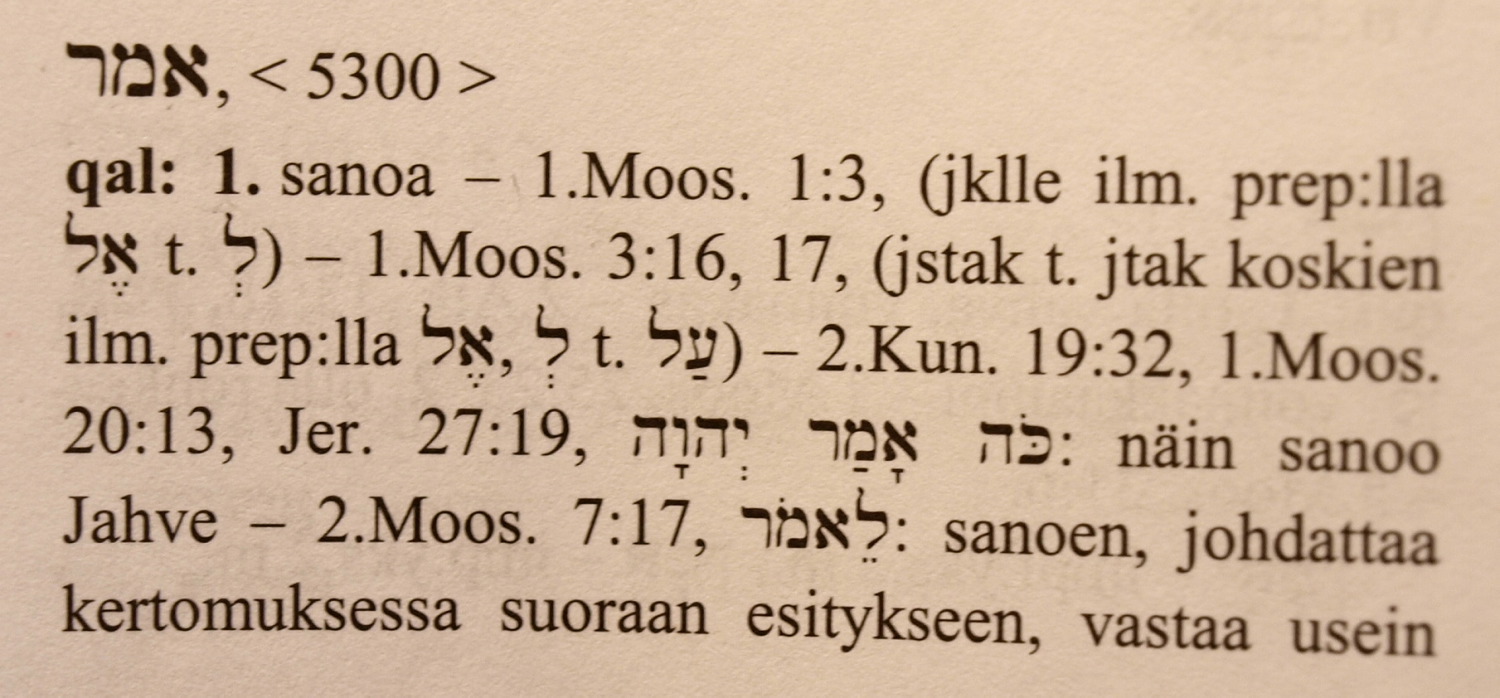
Lauseen kuudes sana on maskuliinisukuinen substantiivi אל (eel):
The sixth word is a substantive in masculine אל (eel):

Edelliseen sanaan liittyvä kakkostyypin suffiksi löytyy seuraavasta taulukosta:
The previous word has a suffix of type 2, which you'll see in the table below:

Lauseen seitsemäs sana on maskuliinisukuinen substantiivi בן (ben), johon liittyvä ykköstyypin suffiksi näkyy edellä olevasta taulukosta:
The seventh word is a substantive in masculine בן (ben), and it's suffix of type 1 you'll find in the table above:

Lauseen kahdeksas ja yhdeksäs sana ovat persoonapronomineja, jotka löytyvät alla olevasta taulukosta:
The eighth and the ninth word are personal pronouns, and you'll find them in the table below:

Lauseen kymmenes sana on maskuliinisukuinen substantiivi יומ (jom), jonka määrätty muoto on היומ (haj-jom):
The tenth word is a substantive in masculine יומ (jom), and it's definite form is חיומ (haj-jom):

HUOM.: Lauseen kymmenenteen sanaan EI LIITY demonstratiivipronominia "tämä", joten ei voida myöskään kääntää "tänä päivänä"!
NOTE: There is NO demonstrative pronoun "this" with the tenth word, therefore we can't translate "this day"!

Lauseen viimeinen sana on verbi ילד (jalad), johon liittyvä suffixi näkyy aikaisemmasta taulukosta:
The last word is a verb ילד (jalad), and you'll find it's suffix in the former table:

Jokainen yrittäköön itse löytää hyvän käännöksen kyseiseen tekstiin!
Try to make your own translation!
Minun ehdotukseni on seuraavanlainen:
MINÄ JULISTAN/KERRON LISÄKSI TEHTÄVÄN
HERRA SANOI JUMALANI
SINÄ (OLET) POIKANI
MINÄ SINÄ PÄIVÄNÄ SINUT SYNNYTÄN
My translation:
I'LL TELL YOU/DECLARE MORE THAN A TASK
THE LORD SAID MY GOD
YOU (ARE) MY SON
THE DAY I'LL GIVE YOU BIRTH
Jos jätämme "lisäykseltä" tuntuvan toisen rivin pois, syntyy järkevä ajatus:
LISÄKSI MINÄ JULISTAN TEHTÄVÄN:
SINÄ (OLET) POIKANI,
SINÄ PÄIVÄNÄ MINÄ SYNNYTÄN SINUT.
If we put away the second row, which reminds me of an addition, the idea of the verse is clear:
I'LL TELL YOU MORE THAN A TASK
YOU (ARE) MY SON
THE DAY I'LL GIVE YOU BIRTH
VAI pitäisikö toinen ja kolmas rivi kääntää näin:
HERRA SANOI SINÄ (OLET) JUMALANI POIKANI... mitä järkeä siinä olisi... kuka olisi siis "HERRA", kuka "JUMALA" ja kuka "POIKA"?
OR should we translate the second and the third row like this: THE LORD SAID YOU (ARE) MY GOD MY SON... do you find any sense in it... who is "LORD", who is "GOD" and who is "SON"?
"Se päivä"/"sinä päivänä" viittaa edellisen jakeen ajatukseen Kuninkaan asettamisesta Siionin pyhälle vuorelle, sillä onhan kuoleman voittaminen/ylösnusemus Jeesuksen kuninkuuden totinen perusta!
"The day" refers to the previous verse and it's idea of the moment/day when God set the king upon his holy hill of Zion, for isn't it the defeat of death/resurrection of Jesus that is the base/foundation of his kingdom!
Apostolien tekojen kirjoittaja on ymmärtänyt kyseisen Psalmin ennustuksen toteutuneen juuri Jeesuksen ylösnousemuksessa (Ap.t. 13: 33, 34).
The author of the Acts has understood that the Psalm text in question was fulfilled in the resurrection of Jesus (Acts 13: 33, 34).
Jumalan valtava tehtävä/urakka: TOTEUTTAA PELASTUSSUUNNITELMANSA JEESUKSESSA JA TUODA HÄNET ULOS "HAUDAN KOHDUSTA" KUOLEMAN VOITTAJANA! (vrt. Room. 1: 4)
God's enormous task: TO FULFILL HIS PLAN OF SALVATION IN JESUS AND BRING HIM OUT AS THE VINNER OF DEATH FROM "THE WOMB OF THE TOMB"! (compare Rom. 1: 4)
keskiviikko 24. lokakuuta 2012
Sanal. 8: 22 * Prov. 8: 22
Sanal 8: 22
vuoden 1933 käännöksen mukaan:
"Herra loi minut töittensä esikoiseksi, ensimmäiseksi teoistaan, ennen aikojen alkua."
vuoden 1992 käännöksen mukaan:
"Minut Herra loi ennen kaikkea muuta, luomisensa esikoisena, ennen taivasta ja maata."
vuoden 2012 käännöksen mukaan:
"Herra omisti minut tiensä alussa, muinaisuudessa, ennen kuin hän oli tehnyt mitään."
Prov. 8: 22 (Webster and KJV):
"The LORD possessed me in the beginning of his way, before his works of old."
Sanal. 8: 22 hepreaksi:
Prov. 8: 22 in Hebrew:

Jakeen sisältämät sanat sanakirjasta:
Words found in a lexicon:
Ensimmäinen sana oikealta.
The first word on the right hand.

Kysymyksessä on siis tetragrammi, joka yleensä suomennetaan sanalla "Herra".
It's question about the tetragrammaton usually translated into English "the Lord".
Seikka mikä minua hämmästyttää aivan ensimmäiseksi on se, että tämän lauseen aloittaa subjekti eikä predikaatti, eli tässä lauseessa on väärä sanajärjestys!
The first thing I'm wondering here is a wrong word order. A Hebrew sentence begings with a predicate/verb, but in this sentence the first word is a subject/substantive.
Toinen sana oikealta.
The second word on the right hand.

Hepreankieliset verbit on ilmoitettu sanakirjassa perusmuodossaan kolmella konsonantilla. Tekstin sana קנני (qanani) on yks.3. pers.:n muodossa ja siihen liittyy pronominaali suffixi tarkoittaen "hän osti minut", "hän hankki minut". Ilmeisesti tästä verbistä on johdettu "hän omisti minut", mutta millä perusteella?
The basic forms of the Hebrew verbs are informed in a lexicon with three consonants. The verb in the text of Proverbs is in the form: קנני - qanani (in the 3rd person in singular) and it has a pronominal suffix meaning "he bought me". Perhaps the word "possessed" is derived from this verb, but on what basis?
Jumala todella osti/hankki takaisin (itselleen jo luomisen perusteella kuuluvan) hallintavallan, jonka Saatana oli häneltä riistänyt väittäessään tätä planeettaa omakseen. Hinta oli Jeesus, joka ei suostunut kumartamaan "tämän maailman ruhtinasta" vaan osoitti tinkimätöntä kuuliaisuutta Jumalan tahdolle (Matt. 4: 9, 10). Kuuliaisuutensa ansiosta Jeesus voitti kuoleman, joka oli Saatanan vaatima hinta.
In a matter of fact God bought his rights (which already were his on the basis of the creation) back from Satan, who claimed that this planet belongs to him. The price was Jesus who didn't fall down before "the prince of this world" but was unconditionally obedient to God's will (Matthew 4. 9, 10). Thanks to his obedience Jesus defeated the death, which was the price Satan was demanding.
קנה on perusmuoto myös verbille, joka merkitsee "luoda", "saada aikaan", eli tekstin קנני (qanani) voidaan kääntää myös "hän loi minut", "hän sai minut
aikaan".
קנה is a basic form also for a verb meaning "create", "cause", therefore קנני (qanani) means also "he created me", "he caused me"
Kolmas sana...
The third word...

Tekstissä tämän sanan edessä ei ole mitään prepositiota, joten sana ראשית (reshit) on käännettävä perusmuodossaan "alku". Ei voida kääntää "alussa", koska sanan edestä puuttuu prepositio ב , jollainen muoto löytyy mm. 1. Moos. 1: 1:ssa ja Joh. 1: 1:ssa.
There is no preposition before this word ראשית (reshit) in the text of Proverbs, and this word must be translated in it's basic form "beginning". Because the preposition ב is lacking, we are not allowed to say "in the beginning" like in Gen. 1: 1 and John 1: 1:
Sanakirjaotteen kohdassa 3. on esimerkki Jeremian kirjasta kyseisen sanan käytöstä: ראשית אונ (reshit on), joka merkitsee siis "isän ensimmäinen lapsi", "esikoinen". Suomenkielisissä käännöksissä vuosilta 1933 ja 1992 on käytetty sanaa "esikoinen", vaikka kyseisessä Sananlaskujen tekstissä ei ole sanaa אונ ollenkaan! Mielestäni niin ei voida tehdä!
In the note above there is an example from the book of Jeremiah how to use this word: ראשית אונ (reshit on) means "father's first child", "firstborn" (="esikoinen" in Finnish). The word "esikoinen" has been used in the Finnish versions although the word אונ is lacking from the text of Proverbs. I don't like it!
Neljäs sana ...
The fourth word...

Tähän sanaan דרך (derek) liittyy tekstissä ykköstyypin suffixi, joka muuttaa sanan muotoon דרכו (darko) tarkoittaen "hänen suunnitelmansa", "hänen tiensä".
דרך (derek) means "way", "plan" and in the text of Proverbs this word has also a suffix of type 1... דרכו (darko) meaning "his way", "his plan".
Tämä ja edellinen sana muodostavat heprean kielen genetiivin, ja käännös on: "hänen suunnitelmansa alku", "hänen tiensä alku".
This word forms "construct chain" or genetive with the word before it meaning " the beginning of his way", "the beginning of his plan".
Sana דרך (derek) esiintyy myös Joh. 14: 6:ssa määrätyssä muodossa הדרך (ha-derek).
The word דרך (derek) appears also in John 14: 6 in the definite form הדרך (ha-derek).
Viides sana...
The fifth word...

Sanakirjassa kolmosella merkitty vaihtoehto "muinoin" tuntuisi luontevimmalta vaihtoehdolta sanalle קדם (qedem) tässä yhteydessä.
"muinoin" = "very long ago" sounds the best alternative for the word קדם (qedem).
Kuudes sana...
The sixth word...

Tekstissä tähän sanaan מפעל (mipal) liittyy kakkostyypin suffixi, joka viittaa useisiin kohteisiin: "tekoja", "töitä"
Jumalan tärkeimmät työt ovat luominen ja lunastus.
This word מפעל (mipal) means "deed", "work", but there is a suffix of the type 2 in the text referring to many "deeds", "works". God's most important deeds/works are creation and redemption.
Seitsemäs sana...
The seventh word...

Käännöksissä tämä sana מאז (meaz) kuuluu edellisen sanan eteen, ja kun sen sanan kakkostyypin suffixi huomioidaan, käännös kuuluu "ennen tekojaan", "ennen töitään".
This word מאז (meaz) means "before" and of course we must put it before the previous word, which means (with it's suffix of type2) "before his works".
Koko lauseen käännös: Herra hankki/loi/sai aikaan minut suunnitelmansa/tiensä alun, muinoin, ennen töitään.
Translation to the whole sentence: Lord bought/created me, the beginning of his plan/way very long ago, before his works.
On siis kysymys suunnitelmasta ja sen toteuttamisesta (työstä). Jumalan pelastussuunnitelma on ollut valmiina jo ennen maailman luomista. Syntiinlankeemuksen jälkeen Jumala ilmoitti sen Eedenissä ensimmäisen kerran Adamille ja Eevalle (1. Moos. 3: 15). Tuohon suunnitelmaan uskomalla ihmiset pelastuivat koko Vanhan Liiton ajan. Uuden Liiton puolella pelastus on lahjoitettu jokaiselle, joka uskoo tuon suunnitelman toteutukseen. Jeesuksessa (vrt. "tie" Joh. 14: 6), Jumalan Sana tuli lihaksi (Joh. 1: 14), kun Jumalan laatima aika täyttyi (Matt. 26: 18; Mark. 1: 15).
It's question of a plan and it's fulfillment (deed/work). God's plan for the salvation was ready before the creation. After the Fall God informed it the first time to Adam and Eve (Gen. 3: 15). People who believed in it were saved in the Old Covenant. And people who believe in it's fulfillment are saved in the New Covenant. In Jesus (compare "way" John 14: 6) God's Word was made flesh (John 1: 14) when the time planned by God was fulfilled (Matthew 26: 18; Mark 1: 15).
TUTKI ITSE!
STUDY BY YOURSELF!
vuoden 1933 käännöksen mukaan:
"Herra loi minut töittensä esikoiseksi, ensimmäiseksi teoistaan, ennen aikojen alkua."
vuoden 1992 käännöksen mukaan:
"Minut Herra loi ennen kaikkea muuta, luomisensa esikoisena, ennen taivasta ja maata."
vuoden 2012 käännöksen mukaan:
"Herra omisti minut tiensä alussa, muinaisuudessa, ennen kuin hän oli tehnyt mitään."
Prov. 8: 22 (Webster and KJV):
"The LORD possessed me in the beginning of his way, before his works of old."
Sanal. 8: 22 hepreaksi:
Prov. 8: 22 in Hebrew:

Jakeen sisältämät sanat sanakirjasta:
Words found in a lexicon:
Ensimmäinen sana oikealta.
The first word on the right hand.

Kysymyksessä on siis tetragrammi, joka yleensä suomennetaan sanalla "Herra".
It's question about the tetragrammaton usually translated into English "the Lord".
Seikka mikä minua hämmästyttää aivan ensimmäiseksi on se, että tämän lauseen aloittaa subjekti eikä predikaatti, eli tässä lauseessa on väärä sanajärjestys!
The first thing I'm wondering here is a wrong word order. A Hebrew sentence begings with a predicate/verb, but in this sentence the first word is a subject/substantive.
Toinen sana oikealta.
The second word on the right hand.

Hepreankieliset verbit on ilmoitettu sanakirjassa perusmuodossaan kolmella konsonantilla. Tekstin sana קנני (qanani) on yks.3. pers.:n muodossa ja siihen liittyy pronominaali suffixi tarkoittaen "hän osti minut", "hän hankki minut". Ilmeisesti tästä verbistä on johdettu "hän omisti minut", mutta millä perusteella?
The basic forms of the Hebrew verbs are informed in a lexicon with three consonants. The verb in the text of Proverbs is in the form: קנני - qanani (in the 3rd person in singular) and it has a pronominal suffix meaning "he bought me". Perhaps the word "possessed" is derived from this verb, but on what basis?
Jumala todella osti/hankki takaisin (itselleen jo luomisen perusteella kuuluvan) hallintavallan, jonka Saatana oli häneltä riistänyt väittäessään tätä planeettaa omakseen. Hinta oli Jeesus, joka ei suostunut kumartamaan "tämän maailman ruhtinasta" vaan osoitti tinkimätöntä kuuliaisuutta Jumalan tahdolle (Matt. 4: 9, 10). Kuuliaisuutensa ansiosta Jeesus voitti kuoleman, joka oli Saatanan vaatima hinta.
In a matter of fact God bought his rights (which already were his on the basis of the creation) back from Satan, who claimed that this planet belongs to him. The price was Jesus who didn't fall down before "the prince of this world" but was unconditionally obedient to God's will (Matthew 4. 9, 10). Thanks to his obedience Jesus defeated the death, which was the price Satan was demanding.
קנה on perusmuoto myös verbille, joka merkitsee "luoda", "saada aikaan", eli tekstin קנני (qanani) voidaan kääntää myös "hän loi minut", "hän sai minut
aikaan".
קנה is a basic form also for a verb meaning "create", "cause", therefore קנני (qanani) means also "he created me", "he caused me"
Kolmas sana...
The third word...

Tekstissä tämän sanan edessä ei ole mitään prepositiota, joten sana ראשית (reshit) on käännettävä perusmuodossaan "alku". Ei voida kääntää "alussa", koska sanan edestä puuttuu prepositio ב , jollainen muoto löytyy mm. 1. Moos. 1: 1:ssa ja Joh. 1: 1:ssa.
There is no preposition before this word ראשית (reshit) in the text of Proverbs, and this word must be translated in it's basic form "beginning". Because the preposition ב is lacking, we are not allowed to say "in the beginning" like in Gen. 1: 1 and John 1: 1:
Sanakirjaotteen kohdassa 3. on esimerkki Jeremian kirjasta kyseisen sanan käytöstä: ראשית אונ (reshit on), joka merkitsee siis "isän ensimmäinen lapsi", "esikoinen". Suomenkielisissä käännöksissä vuosilta 1933 ja 1992 on käytetty sanaa "esikoinen", vaikka kyseisessä Sananlaskujen tekstissä ei ole sanaa אונ ollenkaan! Mielestäni niin ei voida tehdä!
In the note above there is an example from the book of Jeremiah how to use this word: ראשית אונ (reshit on) means "father's first child", "firstborn" (="esikoinen" in Finnish). The word "esikoinen" has been used in the Finnish versions although the word אונ is lacking from the text of Proverbs. I don't like it!
Neljäs sana ...
The fourth word...

Tähän sanaan דרך (derek) liittyy tekstissä ykköstyypin suffixi, joka muuttaa sanan muotoon דרכו (darko) tarkoittaen "hänen suunnitelmansa", "hänen tiensä".
דרך (derek) means "way", "plan" and in the text of Proverbs this word has also a suffix of type 1... דרכו (darko) meaning "his way", "his plan".
Tämä ja edellinen sana muodostavat heprean kielen genetiivin, ja käännös on: "hänen suunnitelmansa alku", "hänen tiensä alku".
This word forms "construct chain" or genetive with the word before it meaning " the beginning of his way", "the beginning of his plan".
Sana דרך (derek) esiintyy myös Joh. 14: 6:ssa määrätyssä muodossa הדרך (ha-derek).
The word דרך (derek) appears also in John 14: 6 in the definite form הדרך (ha-derek).
Viides sana...
The fifth word...

"muinoin" = "very long ago" sounds the best alternative for the word קדם (qedem).
Kuudes sana...
The sixth word...

Tekstissä tähän sanaan מפעל (mipal) liittyy kakkostyypin suffixi, joka viittaa useisiin kohteisiin: "tekoja", "töitä"
Jumalan tärkeimmät työt ovat luominen ja lunastus.
This word מפעל (mipal) means "deed", "work", but there is a suffix of the type 2 in the text referring to many "deeds", "works". God's most important deeds/works are creation and redemption.
Seitsemäs sana...
The seventh word...

This word מאז (meaz) means "before" and of course we must put it before the previous word, which means (with it's suffix of type2) "before his works".
Koko lauseen käännös: Herra hankki/loi/sai aikaan minut suunnitelmansa/tiensä alun, muinoin, ennen töitään.
Translation to the whole sentence: Lord bought/created me, the beginning of his plan/way very long ago, before his works.
On siis kysymys suunnitelmasta ja sen toteuttamisesta (työstä). Jumalan pelastussuunnitelma on ollut valmiina jo ennen maailman luomista. Syntiinlankeemuksen jälkeen Jumala ilmoitti sen Eedenissä ensimmäisen kerran Adamille ja Eevalle (1. Moos. 3: 15). Tuohon suunnitelmaan uskomalla ihmiset pelastuivat koko Vanhan Liiton ajan. Uuden Liiton puolella pelastus on lahjoitettu jokaiselle, joka uskoo tuon suunnitelman toteutukseen. Jeesuksessa (vrt. "tie" Joh. 14: 6), Jumalan Sana tuli lihaksi (Joh. 1: 14), kun Jumalan laatima aika täyttyi (Matt. 26: 18; Mark. 1: 15).
It's question of a plan and it's fulfillment (deed/work). God's plan for the salvation was ready before the creation. After the Fall God informed it the first time to Adam and Eve (Gen. 3: 15). People who believed in it were saved in the Old Covenant. And people who believe in it's fulfillment are saved in the New Covenant. In Jesus (compare "way" John 14: 6) God's Word was made flesh (John 1: 14) when the time planned by God was fulfilled (Matthew 26: 18; Mark 1: 15).
TUTKI ITSE!
STUDY BY YOURSELF!
lauantai 13. lokakuuta 2012
Alkukielten rikkaus * Rich original languages
Koen asian hyvin puutteelliseksi, jos lukiessamme/tutkiessamme raamattua, joudumme tyytymään ainoastaan käännöksiin ja moneen kertaan uudistettuihin versioihin.
I think it's very defective, if we must be content with translations and with many times renewed versions when we are reading/analysing the Bible.
Alkukielten rikas merkitys ja monivivahteisuus jää siten meiltä kokonaan tietämättä. Ja vielä vakavampi seikka on se, että pysymme hurskaassa uskossa manipuloituihin ja tietyssä tarkoituksessa tehtyihin teksteihin.
Then we can't know anything of the verbal richness and the nuanced meanings of the original languages. And the more serious thing is that we know nothing of the manipulated texts made on a certain purpose.
Valitettavasti näyttää kuitenkin olevan niin, että kun kansa on vuosikausien aikana tottunut tiettyihin pyhiksi koettuihin sanavalintoihin, raamatun alkutekstejä penkova henkilö koetaan kenties häiritseväksi tekijäksi tyyliin; mikähän sekin oikein luulee olevansa.
Unfortunately It seems to be that when people have been used to listen to the certain "holy" words, some single person rooting the original texts may disturb them, and they are asking: what special she/he is imaging to be.
Kuitenkin monet uskonpuhdistajat ovat korostaneet raamatun alkukielten tärkeyttä ja niiden osaamisen merkitystä.
However many leaders of reformation have emphasized the importance of the origin languages.
Jokainen meistä joutuu Jumalan eteen yksilönä. Emmekä siinä tilanteessa voi tukeutua sen tapaisiin puolustuksiin kuin: no, kun minulle opetettiin niin ja niin... tai... kun sekin pappi oli sitä mieltä, että... jne. jne.
Every one of us has to face God personally. We can't defend ourselves before him saying: oh, I was just taught in this way... or... it was one priest who told me so... etc. etc.
Sen tähden koen tärkeäksi, että niin moni kuin mahdollista alkaisi opiskella hepreaa ja kreikkaa, ja ottaa itse selvää asioista! Siitä avautuu kokonaan uusi näkymä raamatun kertomuksiin ja profetioihin.
Therefore I hope that as many as possible shall begin to study Hebrew and Greek and find out the Bible texts by themselves! A totally view shall be opened to the Bible stories and prophecies.
Syksy on aina vilkasta uusien harrastusten aloittamisen aikaa, joten nyt opiskelemaan jompaa kumpaa tai vaikka molempia!
People use to beging new things and hobbies in Autumn. Why not Hebrew or Greek or both of them!
I think it's very defective, if we must be content with translations and with many times renewed versions when we are reading/analysing the Bible.
Alkukielten rikas merkitys ja monivivahteisuus jää siten meiltä kokonaan tietämättä. Ja vielä vakavampi seikka on se, että pysymme hurskaassa uskossa manipuloituihin ja tietyssä tarkoituksessa tehtyihin teksteihin.
Then we can't know anything of the verbal richness and the nuanced meanings of the original languages. And the more serious thing is that we know nothing of the manipulated texts made on a certain purpose.
Valitettavasti näyttää kuitenkin olevan niin, että kun kansa on vuosikausien aikana tottunut tiettyihin pyhiksi koettuihin sanavalintoihin, raamatun alkutekstejä penkova henkilö koetaan kenties häiritseväksi tekijäksi tyyliin; mikähän sekin oikein luulee olevansa.
Unfortunately It seems to be that when people have been used to listen to the certain "holy" words, some single person rooting the original texts may disturb them, and they are asking: what special she/he is imaging to be.
Kuitenkin monet uskonpuhdistajat ovat korostaneet raamatun alkukielten tärkeyttä ja niiden osaamisen merkitystä.
However many leaders of reformation have emphasized the importance of the origin languages.
Jokainen meistä joutuu Jumalan eteen yksilönä. Emmekä siinä tilanteessa voi tukeutua sen tapaisiin puolustuksiin kuin: no, kun minulle opetettiin niin ja niin... tai... kun sekin pappi oli sitä mieltä, että... jne. jne.
Every one of us has to face God personally. We can't defend ourselves before him saying: oh, I was just taught in this way... or... it was one priest who told me so... etc. etc.
Sen tähden koen tärkeäksi, että niin moni kuin mahdollista alkaisi opiskella hepreaa ja kreikkaa, ja ottaa itse selvää asioista! Siitä avautuu kokonaan uusi näkymä raamatun kertomuksiin ja profetioihin.
Therefore I hope that as many as possible shall begin to study Hebrew and Greek and find out the Bible texts by themselves! A totally view shall be opened to the Bible stories and prophecies.
Syksy on aina vilkasta uusien harrastusten aloittamisen aikaa, joten nyt opiskelemaan jompaa kumpaa tai vaikka molempia!
People use to beging new things and hobbies in Autumn. Why not Hebrew or Greek or both of them!
sunnuntai 7. lokakuuta 2012
Sanojen verkko * A word web
Sanat muodostavat hyvin mielenkiintoisia yhteyksiä toisiinsa. Sain kokea sen jälleen kerran, kun eräs henkilö kysyi minulta, mitä merkitsee hepreankielinen sana "hatikva".
Words have many interesting links with each others. I found it once again when I was asked, what means a Hebrew word "hatikva".
Ensiksi huomasin, että kyseessä on sana, joka kirjoitetaan hepreaksi תקוה eli Tiqva, ja että Ha-Tiqva on vain määrätty muoto kyseisesta sanasta, ja että sana tarkoittaa "toivo".
At first I found that the word in question is spelled in Hebrew תקוה or Tiqva and Ha-Tiqva is the same word in the definite form and that the word means "hope".

Ha-Tiqva on israelilaisten kansallislaulu, ja se on myös miehen nimi ( 2. Kun. 22: 14; Esra 10: 15) aivan samoin kuin "Toivo" on Suomessa miehen nimi.
Ha-Tiqva is the national hymn of Israel, and also a male name (2.Kings 22: 14; Ezra 10: 15) in the same way as "Toivo" in Finland.
Mutta sanakirja paljasti myös todella mielenkiintoisen yksityiskohdan kyseisestä sanasta. Sama sana merkitsee myös "nauha", "lanka", "naru".
But in a wordbook I found a very interesting detale. The same word means also "ribbon", "thread", "rope/line".

Punainen nauha Raahabin ikkunassa oli TOIVON merkki, sillä sen avulla hän ja hänen perheensä pelastuivat tuholta Jerikon muurien sortuessa alas (Joos. 2. luku).
A red line bounded in Rahab's window was a sign of HOPE, for thanks to it she and her family rescued when the walls of Jerico were crumbling down (the second chapter of Joshua).
Words have many interesting links with each others. I found it once again when I was asked, what means a Hebrew word "hatikva".
Ensiksi huomasin, että kyseessä on sana, joka kirjoitetaan hepreaksi תקוה eli Tiqva, ja että Ha-Tiqva on vain määrätty muoto kyseisesta sanasta, ja että sana tarkoittaa "toivo".
At first I found that the word in question is spelled in Hebrew תקוה or Tiqva and Ha-Tiqva is the same word in the definite form and that the word means "hope".

Ha-Tiqva on israelilaisten kansallislaulu, ja se on myös miehen nimi ( 2. Kun. 22: 14; Esra 10: 15) aivan samoin kuin "Toivo" on Suomessa miehen nimi.
Ha-Tiqva is the national hymn of Israel, and also a male name (2.Kings 22: 14; Ezra 10: 15) in the same way as "Toivo" in Finland.
Mutta sanakirja paljasti myös todella mielenkiintoisen yksityiskohdan kyseisestä sanasta. Sama sana merkitsee myös "nauha", "lanka", "naru".
But in a wordbook I found a very interesting detale. The same word means also "ribbon", "thread", "rope/line".

Punainen nauha Raahabin ikkunassa oli TOIVON merkki, sillä sen avulla hän ja hänen perheensä pelastuivat tuholta Jerikon muurien sortuessa alas (Joos. 2. luku).
A red line bounded in Rahab's window was a sign of HOPE, for thanks to it she and her family rescued when the walls of Jerico were crumbling down (the second chapter of Joshua).
lauantai 15. syyskuuta 2012
ELOHIM ei ole Ilmarinen * ELOHIM is not Ilmarinen
Tutkiessamme elohistista luomiskertomusta (1. Moos. 1: 1 - 2: 4a) Hepreapiirissämme, olemme hämmästyneet siinä esiintyvien verbien ristiriitaista viestiä.
When we have been studying the Elohistic creation story (Gen. 1: 1 - 2: 4a) in a small Hebrew group, we have get astonished with the ambivalent message of the verbs appearing in it.
Itse RUACH ELOHIM eli VALTAVA HENKI on tekijänä/luojana elohistisessa luomiskertomuksessa. VALTAVAN HENGEN tekemiset eivät ymmärtääksemme ole mitään nikkarointia eikä näpertelyä... senhän medän pitäisi nähdä jo omin silmin... katsommepa mihin suuntaan tahansa.
RUACH ELOHIM himself or THE ENORMOUS SPIRIT is the actor/creator in the Elohistic creation story. The doings of that ENORMOUS SPIRIT are not just making or tinkering... we should see it by own eyes... no matter what we are looking at around us.
Verbi ברא, joka esiintyy sekä elohistisen luomiskertomuksen alussa (1: 1) että sen lopussa (2: 4a) sopii loistavasti kuvaamaan tuon suuren ja väkevän HENKI-JUMALAN luomistyötä. Kyseinen verbi tarkoittaa nimittäin "TEHDÄ OLEMATTOMASTA OLEVA".
The verb ברא, which appears both in the beginning (Gen. 1: 1) and at the end (Gen. 2: 4a) of the Elohistic creation story, illustrates perfectly the creation of that great and mighty SPIRIT-GOD. The verb means " to CREATE EXISTING THINGS FROM NOTHING".
ELOHIM käytti maailmaa ja universumia luodessaan sanansa voimaa, sillä meille kerrotaan, että "Jumala sanoi" (1. Moos. 1: 3, 6, 9, 11, 14, 20, 24, 26). Tuota valtavaa työskentelytapaa kuvataan myös eräässä psalmissa: "Sillä hän sanoi, ja tapahtui niin, hän käski, ja se oli tehty" (Ps. 33: 9).
When creating the earth and the universe God used the power of his word, as we are told that "God said" (Gen. 1: 3, 6, 9, 11, 14, 20, 24, 26). Also a psalmist describes this immense mean of working: "For he spoke, and it was [done]; he commanded, and it stood fast" (Ps. 33: 9).
ELOHIM on YLIVERTAINEN LUOJA koko maailmankaikkeudessa. Hän jos kuka ansaitsee koko luomakunnan kunnioituksen. Johannes, joka kirjoitti Ilmestyskirjan (viimeinen kirja raamatussa), tajusi varmaan tämän asian merkityksen kirjoittaessaan ensimmäisen enkelin kuuluttamaa sanomaa: "Peljätkää Jumalaa ja antakaa hänelle kunnia, sillä hänen tuomionsa hetki on tullut, ja kumartakaa häntä, joka on tehnyt taivaan ja maan ja meren ja vetten lähteet" (Ilm. 14: 7).
ELOHIM is A SUPREME CREATOR in the whole universe. If somebody isn't he who earns the worship of the whole cosmos. I think that John who wrote the book of Revelation (the last book in the Bible) surely understood this when he spelled the message of the first angel: "Fear God, and give glory to him; for the hour of his judgment is come: and worship him that made heaven, and earth, and the sea, and the fountains of waters" (Rev. 14: 7).
Kuka lienee sitten ollutkaan raamatun ensimmäisen kirjan kirjoittaja, siitä meille ei ole säilynyt mitään varmaa tietoa, mutta tekstin perusteella näyttää siltä, että hänen on ollut vaikea uskoa "tyhjästä tekemiseen" ja "sanalla luomiseen." Siitä antaa viitteitä ne hepreankieliset tekemistä tarkoittavat verbit, joita on sisällytetty sekä elohistiseen että jahvistiseen luomiskertomukseen.
Who ever did write Genesis, we have no sure word of him, but according to the text I think that he had difficulties to believe in "the creation from nothing" and "the creation by a word." We can find this kind of hint in the Hebrew verbs appearing both in the Elohistic and the Yahwistic creation story.
Hepreankielinen verbi עשה, joka esiintyy mm. 1. Moos. 1: 7:ssa ja 2: 4B:ssa merkitsee tekemistä/valmistamista jostakin materiaalista (EI tyhjästä). Verbin merkityksiä ovat mm:
1. tehdä, valmistaa 2. tehdä työtä, työskennellä 3. luoda 4. istuttaa 5. järjestää (pidot) 6. kiinnittää 7. suorittaa, panna täytäntöön. Mainittakoon myös, että samanalkuinen sana עשות merkitsee "työstetty", "taottu".
The Hebrew verb עשה, which appears in Gen. 1: 7 and 2: 4b
means to make/do something from some material (NOT from nothing). It's meanings are among other things:
1. make, produce 2. work, job 3. create 4. plant 5. arrange (party) 6. fix, fasten 7. perfome, execute. Even a word עשות (beginnig similarly) means "worked", "hammered", "forged".
Tästä ei sitten enää olekaan pitkä matka seppo/seppä Ilmariseen, joka on kalevalainen taivaankannen kalkuttaja! Lainaan tässä Kalevalan myyttistä runoa ja Väinämöisen kysymystä: "Oi on seppo veikkoseni. Mitä paukutat pajassa, ajan kaiken kalkuttelet?"
How near is an idea of "seppo Ilmarinen" or a smith forgering the sphere! The Finnish mythical epos Kalevala is telling about Väinämöinen and Ilmarinen. Väinämöinen asked ilmarinen: "O, my brother blacksmith what are you forging in a smith hammering all the time?"
Menneen maailman ihmisten käsitys maasta, taivaasta ja maailmankaikkeudesta samoin kuin heidän puutteelliseen ja rajoitettuun tietoon perustuneet mielikuvansa niiden synnystä kuvastuvat luomiskertomusten tehdä-verbeistä. Ilmeisesti rajallisen ihmisen (joita me kaikki olemme) on äärettömän vaikea käsittää ja uskoa, että jotakin voisi syntyä hetkessä tyhjästä edes silloin, kun ÄÄRETÖN HENKI on tekijänä. Onhan tuollainen verbaalinen äkkiluominen täydellisessä ristiriidassa myös kehitysopin kanssa!
The opinion of the people of the ancient world and their mental images based upon the limited knowledge about the universe are reflecting in the verbs of the creation stories. Obliously limited people (such as we are) have difficulties to understand and believe that something could be created at once and from nothing even when THE ENORMOUS SPIRIT is the creator. Such a verbal creation in a moment is also in an open contradiction with the elovutionary theory!
Kuva raamatusta Jumalan kirjoittamana tai sanelemana kirjana on kuitenkin se, mikä on eniten saanut kolhuja tutkiessamme raamatun tekstiä heprean kielellä. Raamatun teksti on osoittautunut hyvin "inhimilliseksi"... eli juuri siksi, mitä se onkin.
But in our Hebrew Bible group it is the picture of the Bible as a book written or dictated by God has been battered. The Bible has been proved very "human"... such as it really is.
When we have been studying the Elohistic creation story (Gen. 1: 1 - 2: 4a) in a small Hebrew group, we have get astonished with the ambivalent message of the verbs appearing in it.
Itse RUACH ELOHIM eli VALTAVA HENKI on tekijänä/luojana elohistisessa luomiskertomuksessa. VALTAVAN HENGEN tekemiset eivät ymmärtääksemme ole mitään nikkarointia eikä näpertelyä... senhän medän pitäisi nähdä jo omin silmin... katsommepa mihin suuntaan tahansa.
RUACH ELOHIM himself or THE ENORMOUS SPIRIT is the actor/creator in the Elohistic creation story. The doings of that ENORMOUS SPIRIT are not just making or tinkering... we should see it by own eyes... no matter what we are looking at around us.
Verbi ברא, joka esiintyy sekä elohistisen luomiskertomuksen alussa (1: 1) että sen lopussa (2: 4a) sopii loistavasti kuvaamaan tuon suuren ja väkevän HENKI-JUMALAN luomistyötä. Kyseinen verbi tarkoittaa nimittäin "TEHDÄ OLEMATTOMASTA OLEVA".
The verb ברא, which appears both in the beginning (Gen. 1: 1) and at the end (Gen. 2: 4a) of the Elohistic creation story, illustrates perfectly the creation of that great and mighty SPIRIT-GOD. The verb means " to CREATE EXISTING THINGS FROM NOTHING".
ELOHIM käytti maailmaa ja universumia luodessaan sanansa voimaa, sillä meille kerrotaan, että "Jumala sanoi" (1. Moos. 1: 3, 6, 9, 11, 14, 20, 24, 26). Tuota valtavaa työskentelytapaa kuvataan myös eräässä psalmissa: "Sillä hän sanoi, ja tapahtui niin, hän käski, ja se oli tehty" (Ps. 33: 9).
When creating the earth and the universe God used the power of his word, as we are told that "God said" (Gen. 1: 3, 6, 9, 11, 14, 20, 24, 26). Also a psalmist describes this immense mean of working: "For he spoke, and it was [done]; he commanded, and it stood fast" (Ps. 33: 9).
ELOHIM on YLIVERTAINEN LUOJA koko maailmankaikkeudessa. Hän jos kuka ansaitsee koko luomakunnan kunnioituksen. Johannes, joka kirjoitti Ilmestyskirjan (viimeinen kirja raamatussa), tajusi varmaan tämän asian merkityksen kirjoittaessaan ensimmäisen enkelin kuuluttamaa sanomaa: "Peljätkää Jumalaa ja antakaa hänelle kunnia, sillä hänen tuomionsa hetki on tullut, ja kumartakaa häntä, joka on tehnyt taivaan ja maan ja meren ja vetten lähteet" (Ilm. 14: 7).
ELOHIM is A SUPREME CREATOR in the whole universe. If somebody isn't he who earns the worship of the whole cosmos. I think that John who wrote the book of Revelation (the last book in the Bible) surely understood this when he spelled the message of the first angel: "Fear God, and give glory to him; for the hour of his judgment is come: and worship him that made heaven, and earth, and the sea, and the fountains of waters" (Rev. 14: 7).
Kuka lienee sitten ollutkaan raamatun ensimmäisen kirjan kirjoittaja, siitä meille ei ole säilynyt mitään varmaa tietoa, mutta tekstin perusteella näyttää siltä, että hänen on ollut vaikea uskoa "tyhjästä tekemiseen" ja "sanalla luomiseen." Siitä antaa viitteitä ne hepreankieliset tekemistä tarkoittavat verbit, joita on sisällytetty sekä elohistiseen että jahvistiseen luomiskertomukseen.
Who ever did write Genesis, we have no sure word of him, but according to the text I think that he had difficulties to believe in "the creation from nothing" and "the creation by a word." We can find this kind of hint in the Hebrew verbs appearing both in the Elohistic and the Yahwistic creation story.
Hepreankielinen verbi עשה, joka esiintyy mm. 1. Moos. 1: 7:ssa ja 2: 4B:ssa merkitsee tekemistä/valmistamista jostakin materiaalista (EI tyhjästä). Verbin merkityksiä ovat mm:
1. tehdä, valmistaa 2. tehdä työtä, työskennellä 3. luoda 4. istuttaa 5. järjestää (pidot) 6. kiinnittää 7. suorittaa, panna täytäntöön. Mainittakoon myös, että samanalkuinen sana עשות merkitsee "työstetty", "taottu".
The Hebrew verb עשה, which appears in Gen. 1: 7 and 2: 4b
means to make/do something from some material (NOT from nothing). It's meanings are among other things:
1. make, produce 2. work, job 3. create 4. plant 5. arrange (party) 6. fix, fasten 7. perfome, execute. Even a word עשות (beginnig similarly) means "worked", "hammered", "forged".
Tästä ei sitten enää olekaan pitkä matka seppo/seppä Ilmariseen, joka on kalevalainen taivaankannen kalkuttaja! Lainaan tässä Kalevalan myyttistä runoa ja Väinämöisen kysymystä: "Oi on seppo veikkoseni. Mitä paukutat pajassa, ajan kaiken kalkuttelet?"
How near is an idea of "seppo Ilmarinen" or a smith forgering the sphere! The Finnish mythical epos Kalevala is telling about Väinämöinen and Ilmarinen. Väinämöinen asked ilmarinen: "O, my brother blacksmith what are you forging in a smith hammering all the time?"
Menneen maailman ihmisten käsitys maasta, taivaasta ja maailmankaikkeudesta samoin kuin heidän puutteelliseen ja rajoitettuun tietoon perustuneet mielikuvansa niiden synnystä kuvastuvat luomiskertomusten tehdä-verbeistä. Ilmeisesti rajallisen ihmisen (joita me kaikki olemme) on äärettömän vaikea käsittää ja uskoa, että jotakin voisi syntyä hetkessä tyhjästä edes silloin, kun ÄÄRETÖN HENKI on tekijänä. Onhan tuollainen verbaalinen äkkiluominen täydellisessä ristiriidassa myös kehitysopin kanssa!
The opinion of the people of the ancient world and their mental images based upon the limited knowledge about the universe are reflecting in the verbs of the creation stories. Obliously limited people (such as we are) have difficulties to understand and believe that something could be created at once and from nothing even when THE ENORMOUS SPIRIT is the creator. Such a verbal creation in a moment is also in an open contradiction with the elovutionary theory!
Kuva raamatusta Jumalan kirjoittamana tai sanelemana kirjana on kuitenkin se, mikä on eniten saanut kolhuja tutkiessamme raamatun tekstiä heprean kielellä. Raamatun teksti on osoittautunut hyvin "inhimilliseksi"... eli juuri siksi, mitä se onkin.
But in our Hebrew Bible group it is the picture of the Bible as a book written or dictated by God has been battered. The Bible has been proved very "human"... such as it really is.
Tilaa:
Blogitekstit (Atom)