Lienee paikallaan kertoa, miksi kirjoituksissani on raamatun hepreankielinen teksti ilman vokaaleja. Syynä on ensinnäkin se, että kopioin tekstin MacSword'iltä, jossa teksti on kirjoitettu pelkillä konsonanteilla. Toinen syy on se, ettei koneelleni ladatulla heprean aakkostolla voi kirjoittaa muuta kuin konsonantteja. Kolmanneksi blogeillani on jo nyt liikaa kuvia, enkä siis voi käyttää niitä apuna.
May be I must tell you why the Hebrew text in my writings is without vowels. Firstly I copy the text from MacSword, which is without vowels. Secondly the Hebrew alphabets loaded on my computer has no vowels. Thirdly there are already now too many pictures on my blogs, therefore I can't use them.
Konsonanttikirjoitus on kuitenkin aivan yhtä luettavaa kuin heprea on ollut ennen masoreetteja (700 - 1100), jotka kehittivät piste- ja viivamerkit osoittamaan vokaaleja. Ehkä meidän on näin helpompi ymmärtää se tosiasia, että heprean sanojen kanssa on saattanut tulla melkoistakin sekaannusta matkan varrella.
But the text with mere consonants is as readable as it used to be before the Masoretes (700 - 1000 A.D.), who developed the dots and lines to show the vowels. Perhaps it's easier even for us to understand the fact that some confusions may have happened with the words during the centuries.
On huomioitava myös se seikka, että nykyinen neliöfontti sai kanonisen aseman pyhien kirjoitusten ainoana hyväksyttynä kirjoitustapana 2. vuosisadalla (jKr.). Tämä merkitsee sitä, että vasta 100 - 200 jKr. jälkeen pyhiä tekstejä on ikään kuin "uudelleenkirjoitettu" muinaishepreasta neliöfontille.
It's worth to pay attention to one more thing; the present-day square font was accepted in the second century as the only ratified writing for the holy scriptures. It means that not earlier than 100 - 200 A.D. the holy scriptures has been "re-written" from the ancient Hebrew on the square font.
Konsinattikirjoituksen hankaluutta valaiskoon seuraava esimerkki: Jos kirjoitan oman nimeni heprean mallin mukaan (oikealata vasemalle) pelkillä konsonanteilla, nimeni näyttää seuraavalta NNKJ TTJRM NLH. Kuinka monta eri vaihtoehtoa noista konsonanteista saaneekaan! Ei siis ole mikään ihme, että raamatun hepreankielisiä tekstejä lukiessa saattaa törmätä sanaan, jonka merkitystä ei vain yksinkertaisesti tiedetä... enää.
One example of the complexity of the consonant-writing: If I write my name after the Hebrew pattern (from right to left) only by consonants, it'll look like this: NNKJ TTJRM NLH. I wonder how many alternatives you'll get! Therefore it's no wonder if we'll face Hebrew words, which are unknown... the meaning has simple been lost.
sunnuntai 18. marraskuuta 2012

lauantai 10. marraskuuta 2012
Joh. 17: 5 * John 17: 5
"Ja nyt Isä, kirkasta sinä minua itse tykänäs sillä kirkkaudella, joka minulla sinun tykönäs oli ennenkuin tämä maailma olikaan." (1642/1772)
"Ja nyt, Isä, kirkasta sinä minut tykönäsi sillä kirkkaudella, joka minulla oli sinun tykönäsi, ennenkuin maailma olikaan." (1933/38)
"Isä, kirkasta sinä nyt minut, ota minut luoksesi ja anna minulle se kirkkaus, joka minulla oli sinun luonasi jo ennen maailman syntyä." (1992)
"Ja nyt, Isä, kirkasta sinä minut sillä kirkkaudella, joka minulla oli sinun rinnallasi, ennen kuin maailma oli olemassa." (2012)
"And now, O Father, glorify thou me with thy ownself, with the glory which I had with thee before the world was." (Webster)
"And now Father, glorify Me with Yourself with the glory which I had with You before the world was." (MKJV)
ועתה פארני אתה אבי עמך בכבוד אשר היה לי עמך טרם היות העולם
ועתה (ve-attaa) = konjunktio + adverbi/ a conjunction + an adverb:
A. konjunktio/a conjunction
1. ja/and
2. sekä/both
3. sekä että/both and
4. ynnä/plus
5. myös/also
6. niin/so
B. adverbi/an adverb
1. nyt, tällä hetkellä/now, in this moment
2. nyt, tällä kertaa/now, this time
3. nyt, tässä tilanteessa/now, in this situation
4. nyt, edellä tapahtuneiden asioiden perusteella/now, on the base of the previous things
5. nyt, seuraavaksi/now, for the next thing
6. kuitenkin, kaikesta huolimatta/however, in spite of all
7. tähän asti/untill now
פארני (paa'arnii) = pa'ar-verbi + ykköstyypin suffiksi/a verb (pa'ar) + a suffix of type I:
A. verbi/a verb
1. kirkastaa, panna loistamaan/glorify, set to shine
2. koristaa, tehdä kunnioitettavaksi/decorate, make laudable
B. suffiksi/a suffix
1. minun, minua, minut/my, me
אתה (attaa) = persoonapronomini/a personal pronoun:
1. sinä/you
אבי (avii) = maskuliinisubstantiivi + ykköstyypin suffiksi/a substantive in masculine + a suffix of type I:
A. substantiivi/a substantive
1. isä/father
2. isoisä/grandfather
3. esi-isä/ancestor
4. kantaisä/progenitor
B. suffiksi (yks. 1.)/a suffix (1s)
1. minun, minua, minut/my, me
עמך (immeka) = prepositio + ykköstyypin suffiksi/a preposition + a suffix of type I:
A. perositio/a preposition
1. kanssa/with
2. luona/by
3. ja, sekä, sekä että/and, both, both and
4. sen lisäksi, sitäpaitsi/moreover, besides
B. suffiksi (yks. 2. mask.)/a suffix (2ms)
1. sinun, sinua, sinut/your, you
בכבוד (ba-kavod) = prepositio + maskuliinisubstantiivi epämääräisessä muodossa/a preposition + a substantive in masculine and indefinite form:
A. preposition/a preposition
1. -ssa/in
2. -lla/on
3. sisällä, sisäpuolella/in, inside
4. joukossa, keskellä/with, in the midst
B. substantiivi/a substantive
1. arvokkuus, tärkeys, kunnia/worth, importance, honour
2. rikkaus, omaisuus/richness/property
3. ylhäisö, ylhäiset/nobility
4. loisto, ihanuus, vehmaus/shine, glory,luxury
5. kunnia, loisto/honor
אשר (asher) = telatiivipronomini/a relative pronoun:
1. joka/who, that
2. se joka/he who
היה (hajaa) = hajah-verbi/a verb (hajah):
1. tulla, tapahtua/come, happen
2. tapahtua, käydä/occur
3. olla/be
לי (lii) = prepositio + ykköstyypin suffiksi/a preposition + a suffix of type I:
A. prepositio/a preposition
1. jononkin, -lle/ to, for
2. ilmaisee toiminnan kohteen/shows the focus of action
3. asti, saakka/as far as, until
4. aikana/during
5. kuluttua/after
B. suffiksi/a suffix
1. minun, minua, minut/my, me
עמן (immeka)= prepositio + ykköstyypin suffiksi (sama sana aikaisemminkin)/a preposition + a suffix of type I (the same word before):
"Ja nyt, Isä, kirkasta sinä minut tykönäsi sillä kirkkaudella, joka minulla oli sinun tykönäsi, ennenkuin maailma olikaan." (1933/38)
"Isä, kirkasta sinä nyt minut, ota minut luoksesi ja anna minulle se kirkkaus, joka minulla oli sinun luonasi jo ennen maailman syntyä." (1992)
"Ja nyt, Isä, kirkasta sinä minut sillä kirkkaudella, joka minulla oli sinun rinnallasi, ennen kuin maailma oli olemassa." (2012)
"And now, O Father, glorify thou me with thy ownself, with the glory which I had with thee before the world was." (Webster)
"And now Father, glorify Me with Yourself with the glory which I had with You before the world was." (MKJV)
ועתה פארני אתה אבי עמך בכבוד אשר היה לי עמך טרם היות העולם
ועתה (ve-attaa) = konjunktio + adverbi/ a conjunction + an adverb:
A. konjunktio/a conjunction
1. ja/and
2. sekä/both
3. sekä että/both and
4. ynnä/plus
5. myös/also
6. niin/so
B. adverbi/an adverb
1. nyt, tällä hetkellä/now, in this moment
2. nyt, tällä kertaa/now, this time
3. nyt, tässä tilanteessa/now, in this situation
4. nyt, edellä tapahtuneiden asioiden perusteella/now, on the base of the previous things
5. nyt, seuraavaksi/now, for the next thing
6. kuitenkin, kaikesta huolimatta/however, in spite of all
7. tähän asti/untill now
פארני (paa'arnii) = pa'ar-verbi + ykköstyypin suffiksi/a verb (pa'ar) + a suffix of type I:
A. verbi/a verb
1. kirkastaa, panna loistamaan/glorify, set to shine
2. koristaa, tehdä kunnioitettavaksi/decorate, make laudable
B. suffiksi/a suffix
1. minun, minua, minut/my, me
אתה (attaa) = persoonapronomini/a personal pronoun:
1. sinä/you
אבי (avii) = maskuliinisubstantiivi + ykköstyypin suffiksi/a substantive in masculine + a suffix of type I:
A. substantiivi/a substantive
1. isä/father
2. isoisä/grandfather
3. esi-isä/ancestor
4. kantaisä/progenitor
B. suffiksi (yks. 1.)/a suffix (1s)
1. minun, minua, minut/my, me
עמך (immeka) = prepositio + ykköstyypin suffiksi/a preposition + a suffix of type I:
A. perositio/a preposition
1. kanssa/with
2. luona/by
3. ja, sekä, sekä että/and, both, both and
4. sen lisäksi, sitäpaitsi/moreover, besides
B. suffiksi (yks. 2. mask.)/a suffix (2ms)
1. sinun, sinua, sinut/your, you
בכבוד (ba-kavod) = prepositio + maskuliinisubstantiivi epämääräisessä muodossa/a preposition + a substantive in masculine and indefinite form:
A. preposition/a preposition
1. -ssa/in
2. -lla/on
3. sisällä, sisäpuolella/in, inside
4. joukossa, keskellä/with, in the midst
B. substantiivi/a substantive
1. arvokkuus, tärkeys, kunnia/worth, importance, honour
2. rikkaus, omaisuus/richness/property
3. ylhäisö, ylhäiset/nobility
4. loisto, ihanuus, vehmaus/shine, glory,luxury
5. kunnia, loisto/honor
אשר (asher) = telatiivipronomini/a relative pronoun:
1. joka/who, that
2. se joka/he who
היה (hajaa) = hajah-verbi/a verb (hajah):
1. tulla, tapahtua/come, happen
2. tapahtua, käydä/occur
3. olla/be
לי (lii) = prepositio + ykköstyypin suffiksi/a preposition + a suffix of type I:
A. prepositio/a preposition
1. jononkin, -lle/ to, for
2. ilmaisee toiminnan kohteen/shows the focus of action
3. asti, saakka/as far as, until
4. aikana/during
5. kuluttua/after
B. suffiksi/a suffix
1. minun, minua, minut/my, me
עמן (immeka)= prepositio + ykköstyypin suffiksi (sama sana aikaisemminkin)/a preposition + a suffix of type I (the same word before):
A. perositio/a preposition
1. kanssa/with
2. luona/by
3. ja, sekä, sekä että/and, both, both and
4. sen lisäksi, sitäpaitsi/moreover, besides
B. suffiksi (yks. 2. mask.)/a suffix (2ms)
1. sinun, sinua, sinut/your, you
Huom! Tämä sana esiintyy kyseisessä jakeessa kaksi kertaa; edellisellä kerralla mem-konsonantin alla on vokaalina Segol mutta tässä Shewa (?)
Attention! This word appears twice in this verse; with a vowel Seghol under Mem before, but now with Shewa (?)
תרם (terem) = adverbi/an adverb:
1. ei vielä/not yet
2. ennen kuin/before
3. ennen/once
היות (hejot) = hajah-verbi/a verb (hajah):
1. tulla, tapahtua/come, happen
2. tapahtua, käydä/occur
3. olla/be
Tämän verbi ihmetyttää minua, mutta näyttää siltä, että se on yleensä käännetty sanalla "oli". (vrt. sama verbi aikaisemmin)
I'm wondering this verb, but usually it has been translated with a word "was". (compare the same verb before)
העולם (ha-olam) = määrätyssä muodossa oleva maskuliinisubstantiivi/a masculine-substantive in the definite form:
1. kaukainen aika, loppuelämä, elinikä/distant time, rest of one's life, lifetime
2. ikivanha, muinainen/ancient
3. iankaikkinen, ikuinen/eternal, everlasting
Huom! Tämä sana on käännetty lähes poikkeuksetta sanalla "maailma", mutta Matti Liljeqvistin Vanhan Testamentin Heprean ja Aramean Sanakirjan mukaan niin ei ole tehty kertaakaan Vanhan Testamentin puolella.
Attention! Invariably this word has been translated with a word "world", but according my lexicon there is not such a case in the Old testament at all.
Minun käännösehdotukseni sanasta sanaan on seuraavanalainen:
SIKSI (= edellä tapahtuneen perusteella/vrt. edellinen jae) KIRKASTA MINUT SINÄ ISÄNI KANSSASI KUNNIASSA, JOKA OLI MINULLE KANSSASI ENNEN KUIN OLI SE IKUINEN.
My translation from word to word is:
THEREFORE (= on the base of the previous things/compare the previous verse) GLORIFY ME YOU MY FATHER WITH YOU IN HONOUR THAT WAS FOR ME WITH YOU BEFORE THE EVERLASTING WAS.
לי (lii ) = MINULLE. Isän luona oli siis jotakin Pojalle/Poikaa koskevaa. Jos Poika itse olisi ollut Isän luona, ei tarvittaisi prepositiota ל ollenkaan, vaan sen tilalla olisi personapronomini אני (minä). Mitä Isän luona oli POJALLE? Isän laatima suunnitelma siitä, miten ihmiskunta pelastetaan ja kuolema voitetaan.
לי (lii ) = FOR ME. With the Father there was something for the Son/concerning the Son. If the Son himself were with the Father, the text should have been written without the preposition ל, and there might be a personal pronoun אני (I) instead. What was there with the Father FOR the SON? There was a plan/project/view made by the Father how to save the mankind and defeat the death.
SIKSI (= edellä tapahtuneen perusteella/vrt. edellinen jae) KIRKASTA MINUT SINÄ ISÄNI KANSSASI KUNNIASSA, JOKA OLI MINULLE KANSSASI ENNEN KUIN OLI SE IKUINEN.
My translation from word to word is:
THEREFORE (= on the base of the previous things/compare the previous verse) GLORIFY ME YOU MY FATHER WITH YOU IN HONOUR THAT WAS FOR ME WITH YOU BEFORE THE EVERLASTING WAS.
לי (lii ) = MINULLE. Isän luona oli siis jotakin Pojalle/Poikaa koskevaa. Jos Poika itse olisi ollut Isän luona, ei tarvittaisi prepositiota ל ollenkaan, vaan sen tilalla olisi personapronomini אני (minä). Mitä Isän luona oli POJALLE? Isän laatima suunnitelma siitä, miten ihmiskunta pelastetaan ja kuolema voitetaan.
לי (lii ) = FOR ME. With the Father there was something for the Son/concerning the Son. If the Son himself were with the Father, the text should have been written without the preposition ל, and there might be a personal pronoun אני (I) instead. What was there with the Father FOR the SON? There was a plan/project/view made by the Father how to save the mankind and defeat the death.
Paavali kutsui tuota suunnitelmaa "salaisuudeksi", "iankaikkiseksi avoitukseksi", "jumalisuuden salaisuudeksi" (Ef. 1: 9, 10; 3: 9 - 11; Kol. 1: 26, 27; 2: 2; 1. Tim. 3: 16) ja Johannes puolestaan "Jumalan salaisuudeksi" (Ilm. 10: 6, 7).
Paul called that plan "mystery", "mystery of godliness" (Eph. 1: 9, 10: 3: 9 - 11; Col. 1: 26, 27; 2: 2; 1. Tim. 3: 16) and John called it "mystery of God" (Rev. 10: 6, 7).
Jeesus lausui nämä sanat (joita olen tutkinut) rukouksessaan juuri ennen kuin taistelu Saatanan kanssa huipentui Getsemanessa ja Golgatalla. Jeesus oli siihen saakka kirkastanut Isän luonteen ja onnistunut lyömään Saatanan joka hetki, mutta suurin tuska ja ahdistus oli vasta edessäpäin. Entäpä jos Jeesus olisi epäonnistunut siinä? Jeesus tarvitsi Isän väkevää apua viimeiseen koetukseen Saatanan kanssa toteuttaakseen Isän jo ikuisuudessa laatiman suunitelman!
Jesus uttered these words (I have been studying) in his prayer just before the fight with Satan was going to culminate in the garden of Gethsemane and on Golgotha. Until that day Jesus had been glorifying the character of the Father and succeeded in winning Satan in every moment, but the greatest pain and angst were just facing him. What about if he had failed then? Jesus needed the Father's powerful help for his final fight with Satan to fulfill the plan the Father had made even in the eternity!
perjantai 9. marraskuuta 2012
Joh. 1: 18 * John 1: 18
"Ei ole kenkään koskaan Jumalaa nähnyt: ainokainen Poika, joka on Isän helmassa, hän ilmoitti meille." (Biblia 1642/1776)
"Jumalaa ei kukaan ole koskaan nähnyt. Ainoa Poika, joka itse on Jumala ja joka aina on Isän vierellä, on opettanut meidät tuntemaan hänet." (1933/38)
"Jumalaa ei kukaan ole koskaan nähnyt. Ainoa Poika, joka itse on Jumala ja joka aina on Isän vierellä, on opettanut meidät tuntemaan hänet." (1992)
"Jumalaa ei ole kukaan milloinkaan nähnyt. Ainosyntyinen Jumala, joka on Isän rinnalla, on hänet ilmoittanut." (2012)
"No man hath seen God at any time; the only begotten Son, who is in the bosom of the Father, he hath declared [him]." (Webster)
"No one has seen God at any time; the Only-begotten Son, who is in the bosom of the Father, He has declared Him." (MKJV)
את האלהים לא ראה איש מעולם הבן היחיד אשר בחיק האב הוא הודיע
את (et) = erillinen prepositio/an independent preposition
1. ilm. jonkun kanssa olemista tai toimimista/meaning to be or to act with somebody
2. puolella/on one's side
3. yhteydessä/in touch, in contact with
4. tasavertainen jonkun kanssa/equal with
5. avulla/by means of
6. läsnäolossa/in the presence of
7. vieressä, lähellä/beside, near
האלהים (ha-elohim) = monikollinen substantiivi määrätyssä muodossa / a substantive in the definite form and in plural
1. jumala - jumalat - valtava jumala
god - gods - enormous god
לא (lo) = kieltosana/a negative
1. ei/no
ראה (ra'a) = ra'a-verbi/a verb
1. nähdä/to see
2. saada selville/to find out
3. huomata/to notice
4. katsoa, tarkastella/to look at, to gaze at
5. valvoa, pitää huolta/to oversee, to guide
איש (iish) = maskuliini-substantiivi epämääräisessä muodossa/a masculine substantive in the indefinite form
1. mies/man
2. aviomies/husband
3. ihminen/human being
4. poikalapsi/boy child
מעולם (meolam) = adverbi/an adverb
1. (ei) koskaan/(not) ever, never
הבן (ha-ben) = maskuliini-substantiivi määrätyssä muodossa/a masculine substantive in the definite form
1. poika/son
2. pojanpoika/grandson
3. nuori mies/young man
4. jälkeläinen/offspring
היחיד (ha-jachiid) = määrätyssä mudossa oleva adjektiivi/an adjective in the definite form
1. ainoa/only -> the only
2. yksin jätetty, yksinäinen/lonely, left alone
אשר (asher) = relatiivipronomini/a relative pronoun1. joka/that
בחיק (be-cheiq) = kiinteä prepositio + epämääräisessä muodossa oleva maskuliini-substantiivi/an inseparable preposition + a maculine substantive in the indefinite form
A. prepositio/a preposition
1. - ssa/in
B. substantiivi/a substantive
1. syli/bosom
האב (ha-aav) = määrätyssä muodossa oleva maskuliini-substantiivi/a masculine substantive in the definite form
1. isä/father
הוא (huu) = maskuliinissa oleva persoonapronomini (yks. 3.)/a masculine personal pronoun (singular the third)
1. hän/he
הודיע (hoodiia) = verbi/a verb (להודיע)
1. ilmoittaa/report, announce, declare
Minun käännökseni/ehdotukseni sanasta sanaan:
Läsnäolossa Valtavan/Jumalan ei nähnyt ihminen koskaan, (se) poika, (se) ainoa, (se) joka (on) sylissä isän, hän ilmoittaa.
My translation/proposal from word to word:
In the presence of the Enormous/God no man saw ever, (the) son, (the) only, the one who/that is in a bosom of the father, he declares.
Kirkkoisät ovat "kiistelleet" tästä jakeesta, pitääkö käännöksen kuulua "ainosyntyinen poika" vai "ainosyntyinen jumala" (Jumalako syntyisi?) . Itse en löydä viittausta kumpaankaan "ainosyntyiseen", VAAN "ainoaan", "yksinäiseen", "yksin jätettyyn". Jes. 53: 3:ssa kuvataan "lupausten poikaa"/"vaimon siementä" (vrt. 1. Moos. 3: 15) "ihmisten hylkäämäksi". Luulenpa, että juuri tätä Johanneskin tarkoitti.
The church fathers has argued this verse if it should be translated " the only begotten son" or "the only begotten god" (is it possible for God?). I can't find the first nor the second translation, BUT "the only", "lonely" "the one who has been left alone". In Isa. 53: 3 there is a picture of the "promised son"/"the seed of woman" (compare: Gen. 3: 15) as "rejected of men". I think this is what even John was meaning.
Mitä sitten Johannes mahtoi tarkoittaa "Isän sylillä"? Siihenkin löytyy mainio vastaus Jesjalta: "Niinkuin paimen hän kaitsee laumaansa, kokoaa karitsat käsivarrellensa ja kantaa niitä sylissään, johdattelee imettäviä lampaita" (Jes. 40: 11).
What did John mean by the words "a bosom of the father"? Isaiah gives a good answer: "He will feed his flock like a shepherd: he will gather the lambs with his arm, and carry [them] in his bosom, [and] will gently lead those that are with young." (Isa. 40: 11).
Jesajan kuvaus koskee Jeeusta, "hyvää paimenta", mutta koska Jeesus tuli ilmoittamaan Isää, myös Isä on samanlainen "hyvä paimen"! Niin kuin Jeesus hoitaa "lampaitaan", samoin Kaikkivaltias Jumala hoivasi Marian poikaa, jonka piti tiedostaa ja oppia tehtävänsä keskellä Saatanan raivokasta pommitusta. Joka ilta Jeesus vetäytyi yksinäisyyteen rukoilemaan. Isän sylissä... Jumalan läsnäolossa... Jeesus oppi tehtävänsä välittää Jumalan luonne ihmiskunnalle.
Isaiah describes Jesus, "the good shepherd", but because Jesus declared the Father, even he is a good shepherd"! As Jesus cares his "sheep", so did the Almighty took care of Mary's son, who had to learn and be aware of his mission in the midst of Satan's furious bombing. Every evening Jesus turned alone to pray. In a bosom of the Father... in the presence of God... Jesus learned his mission to declare God's character for us.
Koska sana "syli" on epämäärisessä muodossa heprean kielessä, täytyy kysymyksessä olla symboliikka, eikä mikään kirjaimellinen paikka Jumalassa. Mikä sitten onkaan HENKI-Jumalan syli, johon mahtuvat kaikki luodut!
Because the word "bosom" is in the indefinite form in Hebrew, it must be question of symbolism and not of some certain part of God. And what kind is the bosom of the SPIRIT-God offering room for every creature!
"Jumalaa ei kukaan ole koskaan nähnyt. Ainoa Poika, joka itse on Jumala ja joka aina on Isän vierellä, on opettanut meidät tuntemaan hänet." (1933/38)
"Jumalaa ei kukaan ole koskaan nähnyt. Ainoa Poika, joka itse on Jumala ja joka aina on Isän vierellä, on opettanut meidät tuntemaan hänet." (1992)
"Jumalaa ei ole kukaan milloinkaan nähnyt. Ainosyntyinen Jumala, joka on Isän rinnalla, on hänet ilmoittanut." (2012)
"No man hath seen God at any time; the only begotten Son, who is in the bosom of the Father, he hath declared [him]." (Webster)
"No one has seen God at any time; the Only-begotten Son, who is in the bosom of the Father, He has declared Him." (MKJV)
את האלהים לא ראה איש מעולם הבן היחיד אשר בחיק האב הוא הודיע
את (et) = erillinen prepositio/an independent preposition
1. ilm. jonkun kanssa olemista tai toimimista/meaning to be or to act with somebody
2. puolella/on one's side
3. yhteydessä/in touch, in contact with
4. tasavertainen jonkun kanssa/equal with
5. avulla/by means of
6. läsnäolossa/in the presence of
7. vieressä, lähellä/beside, near
האלהים (ha-elohim) = monikollinen substantiivi määrätyssä muodossa / a substantive in the definite form and in plural
1. jumala - jumalat - valtava jumala
god - gods - enormous god
לא (lo) = kieltosana/a negative
1. ei/no
ראה (ra'a) = ra'a-verbi/a verb
1. nähdä/to see
2. saada selville/to find out
3. huomata/to notice
4. katsoa, tarkastella/to look at, to gaze at
5. valvoa, pitää huolta/to oversee, to guide
איש (iish) = maskuliini-substantiivi epämääräisessä muodossa/a masculine substantive in the indefinite form
1. mies/man
2. aviomies/husband
3. ihminen/human being
4. poikalapsi/boy child
מעולם (meolam) = adverbi/an adverb
1. (ei) koskaan/(not) ever, never
הבן (ha-ben) = maskuliini-substantiivi määrätyssä muodossa/a masculine substantive in the definite form
1. poika/son
2. pojanpoika/grandson
3. nuori mies/young man
4. jälkeläinen/offspring
היחיד (ha-jachiid) = määrätyssä mudossa oleva adjektiivi/an adjective in the definite form
1. ainoa/only -> the only
2. yksin jätetty, yksinäinen/lonely, left alone
אשר (asher) = relatiivipronomini/a relative pronoun1. joka/that
בחיק (be-cheiq) = kiinteä prepositio + epämääräisessä muodossa oleva maskuliini-substantiivi/an inseparable preposition + a maculine substantive in the indefinite form
A. prepositio/a preposition
1. - ssa/in
B. substantiivi/a substantive
1. syli/bosom
האב (ha-aav) = määrätyssä muodossa oleva maskuliini-substantiivi/a masculine substantive in the definite form
1. isä/father
הוא (huu) = maskuliinissa oleva persoonapronomini (yks. 3.)/a masculine personal pronoun (singular the third)
1. hän/he
הודיע (hoodiia) = verbi/a verb (להודיע)
1. ilmoittaa/report, announce, declare
Minun käännökseni/ehdotukseni sanasta sanaan:
Läsnäolossa Valtavan/Jumalan ei nähnyt ihminen koskaan, (se) poika, (se) ainoa, (se) joka (on) sylissä isän, hän ilmoittaa.
My translation/proposal from word to word:
In the presence of the Enormous/God no man saw ever, (the) son, (the) only, the one who/that is in a bosom of the father, he declares.
Kirkkoisät ovat "kiistelleet" tästä jakeesta, pitääkö käännöksen kuulua "ainosyntyinen poika" vai "ainosyntyinen jumala" (Jumalako syntyisi?) . Itse en löydä viittausta kumpaankaan "ainosyntyiseen", VAAN "ainoaan", "yksinäiseen", "yksin jätettyyn". Jes. 53: 3:ssa kuvataan "lupausten poikaa"/"vaimon siementä" (vrt. 1. Moos. 3: 15) "ihmisten hylkäämäksi". Luulenpa, että juuri tätä Johanneskin tarkoitti.
The church fathers has argued this verse if it should be translated " the only begotten son" or "the only begotten god" (is it possible for God?). I can't find the first nor the second translation, BUT "the only", "lonely" "the one who has been left alone". In Isa. 53: 3 there is a picture of the "promised son"/"the seed of woman" (compare: Gen. 3: 15) as "rejected of men". I think this is what even John was meaning.
Mitä sitten Johannes mahtoi tarkoittaa "Isän sylillä"? Siihenkin löytyy mainio vastaus Jesjalta: "Niinkuin paimen hän kaitsee laumaansa, kokoaa karitsat käsivarrellensa ja kantaa niitä sylissään, johdattelee imettäviä lampaita" (Jes. 40: 11).
What did John mean by the words "a bosom of the father"? Isaiah gives a good answer: "He will feed his flock like a shepherd: he will gather the lambs with his arm, and carry [them] in his bosom, [and] will gently lead those that are with young." (Isa. 40: 11).
Jesajan kuvaus koskee Jeeusta, "hyvää paimenta", mutta koska Jeesus tuli ilmoittamaan Isää, myös Isä on samanlainen "hyvä paimen"! Niin kuin Jeesus hoitaa "lampaitaan", samoin Kaikkivaltias Jumala hoivasi Marian poikaa, jonka piti tiedostaa ja oppia tehtävänsä keskellä Saatanan raivokasta pommitusta. Joka ilta Jeesus vetäytyi yksinäisyyteen rukoilemaan. Isän sylissä... Jumalan läsnäolossa... Jeesus oppi tehtävänsä välittää Jumalan luonne ihmiskunnalle.
Isaiah describes Jesus, "the good shepherd", but because Jesus declared the Father, even he is a good shepherd"! As Jesus cares his "sheep", so did the Almighty took care of Mary's son, who had to learn and be aware of his mission in the midst of Satan's furious bombing. Every evening Jesus turned alone to pray. In a bosom of the Father... in the presence of God... Jesus learned his mission to declare God's character for us.
Koska sana "syli" on epämäärisessä muodossa heprean kielessä, täytyy kysymyksessä olla symboliikka, eikä mikään kirjaimellinen paikka Jumalassa. Mikä sitten onkaan HENKI-Jumalan syli, johon mahtuvat kaikki luodut!
Because the word "bosom" is in the indefinite form in Hebrew, it must be question of symbolism and not of some certain part of God. And what kind is the bosom of the SPIRIT-God offering room for every creature!
tiistai 6. marraskuuta 2012
Armo ei voi olla armottomuutta * Mercy can't be ruthlessness
Joh. 1: 14 "Ja Sana tuli lihaksi ja asui meidän keskellämme, ja me katselimme hänen kirkkauttansa, senkaltaista kirkkautta, kuin ainokaisella Pojalla on Isältä; ja hän oli täynnä armoa ja totuutta."
John 1: 14 "And the Word was made flesh, and dwelt among us, (and we beheld his glory, the glory as of the only begotten of the Father,) full of grace and truth."
Jeesus tuli kirkastamaan Jumalaa, jota kukaan ei ole nähnyt (Joh. 1: 18), ja hänen ilmoituksensa mukaan, myös JUMALA ON TÄYNNÄ ARMOA JA TOTUUTTA!
Jesus has declared God, whom nobody has ever seen (John 1: 18), and after his declaration even GOD IS FULL OF MERCY AND TRUTH."
Mutta miten Vanhassa Testamentissa annettu kuva kiivaasta koston Jumalasta (Naah. 1: 1) käy yksiin Jeesuksen ilmoituksen kanssa?
But how does the picture given in the Old Testament about the God of wrath and vengeance (Nah. 1: 1) agree with Jesus' declaration?
Minä en suostu uskomaan, että Jumala, joka ilmaisee tahtonsa sanomalla mm. "älä tapa", sortuisi missään olosuhteissa itse tappamaan!
I'm not willing to believe that God who expresses his will by words "Thou shall not kill" shall not begin to kill in any case!
Ennemmin uskon, että Vanhan Testamentin teksteissä on kerrottu kahdesta vastakkaisesta tekijästä; Jumalasta ja hänen vastustajastaan, Saatanasta, ja että jostakin kummallisesta syystä nuo kaksi osapuolta on yhdistetty yhdeksi ja samaksi Jumalaksi.
It's easier for me to believe that two authors, God and Satan, has been mixed in the texts of the Old Testament, and they have been made one.
Mutta tuollainen yhdistelmäjumala ei kuitenkaan kerro totuutta kummastakaan osapuolesta! Siksi on syytä purkaa tuo valheellinen punos, ja katsoa avointa totuutta kummastakin osapuolesta erikseen!
But such a combination doesn't tell the truth of God nor Satan! Therefore it's better to unwind such a false braid and look openly at the truth of both authors!
Meidän on annettu ymmärtää, että Jahve merkitsisi sitä Jumalaa, joka kutsui Moosesta palavasta pensaasta, mutta asiahan ei ole niin, vaan se Jumala on EHJEE (2. Moos. 3: 14). On syytä pitää Ehjee ja Jahve täysin erillään toisistaan, sillä ne eroavat toisistaan kuin päivä ja yö!
We have been taught that Yahweh means God who called Moses from the burning bush, but it is not the truth, for it was EHYEH (Ex. 3: 14). We have a good reason to segregate Ehyeh from Yahweh, for they do differ from each other like a day and a night!
Mikäli tunnemme hämmennystä ja epävarmuutta lukiessamme VT:n kertomuksia sodista, kostosta ja verenvuodatuksista, verratkaamme niitä Jeesuksen antamaan malliin UT:n puolella. Se mikä ei täsmää Jeesuksen periaatteiden kanssa, kuuluu ehdottomasti Jahven leiriin, sillä Jeesus tuli kirkastamaan EHJEEN luonnetta!
If we are ashamed and feel uncertainty when we are reading about the wars, vengeance and bloodshed in the Old Testament, let's contrast them to the pattern of Jesus. Everything that doesn't fit to Jesus' pattern are Yahweh's deeds, for Jesus came to declare EHYEH's character!
John 1: 14 "And the Word was made flesh, and dwelt among us, (and we beheld his glory, the glory as of the only begotten of the Father,) full of grace and truth."
Jeesus tuli kirkastamaan Jumalaa, jota kukaan ei ole nähnyt (Joh. 1: 18), ja hänen ilmoituksensa mukaan, myös JUMALA ON TÄYNNÄ ARMOA JA TOTUUTTA!
Jesus has declared God, whom nobody has ever seen (John 1: 18), and after his declaration even GOD IS FULL OF MERCY AND TRUTH."
Mutta miten Vanhassa Testamentissa annettu kuva kiivaasta koston Jumalasta (Naah. 1: 1) käy yksiin Jeesuksen ilmoituksen kanssa?
But how does the picture given in the Old Testament about the God of wrath and vengeance (Nah. 1: 1) agree with Jesus' declaration?
Minä en suostu uskomaan, että Jumala, joka ilmaisee tahtonsa sanomalla mm. "älä tapa", sortuisi missään olosuhteissa itse tappamaan!
I'm not willing to believe that God who expresses his will by words "Thou shall not kill" shall not begin to kill in any case!
Ennemmin uskon, että Vanhan Testamentin teksteissä on kerrottu kahdesta vastakkaisesta tekijästä; Jumalasta ja hänen vastustajastaan, Saatanasta, ja että jostakin kummallisesta syystä nuo kaksi osapuolta on yhdistetty yhdeksi ja samaksi Jumalaksi.
It's easier for me to believe that two authors, God and Satan, has been mixed in the texts of the Old Testament, and they have been made one.
Mutta tuollainen yhdistelmäjumala ei kuitenkaan kerro totuutta kummastakaan osapuolesta! Siksi on syytä purkaa tuo valheellinen punos, ja katsoa avointa totuutta kummastakin osapuolesta erikseen!
But such a combination doesn't tell the truth of God nor Satan! Therefore it's better to unwind such a false braid and look openly at the truth of both authors!
Meidän on annettu ymmärtää, että Jahve merkitsisi sitä Jumalaa, joka kutsui Moosesta palavasta pensaasta, mutta asiahan ei ole niin, vaan se Jumala on EHJEE (2. Moos. 3: 14). On syytä pitää Ehjee ja Jahve täysin erillään toisistaan, sillä ne eroavat toisistaan kuin päivä ja yö!
We have been taught that Yahweh means God who called Moses from the burning bush, but it is not the truth, for it was EHYEH (Ex. 3: 14). We have a good reason to segregate Ehyeh from Yahweh, for they do differ from each other like a day and a night!
Mikäli tunnemme hämmennystä ja epävarmuutta lukiessamme VT:n kertomuksia sodista, kostosta ja verenvuodatuksista, verratkaamme niitä Jeesuksen antamaan malliin UT:n puolella. Se mikä ei täsmää Jeesuksen periaatteiden kanssa, kuuluu ehdottomasti Jahven leiriin, sillä Jeesus tuli kirkastamaan EHJEEN luonnetta!
If we are ashamed and feel uncertainty when we are reading about the wars, vengeance and bloodshed in the Old Testament, let's contrast them to the pattern of Jesus. Everything that doesn't fit to Jesus' pattern are Yahweh's deeds, for Jesus came to declare EHYEH's character!
perjantai 2. marraskuuta 2012
Nimihaaste * Challenging name
Olen kirjoitellut blogejani elokuusta 2008 alkaen ja käyttänyt nimeä EHJEE taivaan ja maan Luojasta, sanansa luovaa voimaa käyttävästä Kaikkivaltiaasta, iäti olevasta Jaakobin Väkevästä. Tiedän, että tuota nimitystä on ihmettelemällä ihmetelty. Ymmärrän kyllä, olihan kyseinen sana minullekin aikaisemmin täysin vieras. Valintaani vaikuttivat kuitenkin seuraavat seikat:
1. Jumalan omat sanat
2. 2. Moos. 3: 14:n painoarvo Jumalan nimen kohdalla
3. Jumalan nimiä koskevat luettelot
I began to write my blogs in August 2008 and since that Autumn I have used the name EHYEH when speaking about the Creator of the earth and sky, the Almighty using the power of his creative word, the eternal and mighty God of Jacob. I know that people have been astonished because of that name. I can understand, for the name was earlier unknown even to me. Now I want to argue my choice:
1. God's own words
2. The importance of Ex. 3: 14 as a base of God's name
3. The lists concerning God's name
1. Jumalan omat sanat:
Mooseksen saatua Jumalalta kehoituksen johtaa israelilaiset pois Egyptistä hän esitti tälle kansan puolesta kysymyksen "Mikä hänen nimensä on?" (2. Moos. 3:13). Tähän kysymykseen Jumala vastasi hepreaksi אהיה אשר אהיה (ehjee aser ehjee), joka on suomeksi OLEN JOKA OLEN.
Matti Liljeqvistin kokoamassa Vanhan Testamentin Heprean ja Aramean Sanakirjassa todetaan sanan אהיה (ehjee) kohdalla: "Minä olen, Jumalan itsestään käyttämä nimi"
1. God's own words
When God appeared to Moses and asked him to lead the Israelis out of Egypt, Moses asked God on behalf of the Israelis "What is his name?" (Ex. 3: 13). God's answer in Hebrew is אהיה אשר אהיה (ehyeh aser ehyeh), which means (I)AM THAT (I)AM.
Under the word אהיה I can read in my wordbook "I am, the name God used of himself"
2. 2. Moos. 3: 14:n painoarvo Jumalan nimen kohdalla:
Kaikissa lukemissani kirjoituksissa koskien Jumalan nimeksi väitettyä nimeä "Jahvea"/"Jehova" perusteluna ja lähtökohtana pidetään 2. Moos. 3: 14- tekstikohtaa. Näin on siitä huolimatta, ettei Jahvea merkitsevä sana (יהוה) esiinny lainkaan Jumalan Moosekselle antamassa vastauksessa. Katson, että kyseinen teksti on vahvempi perustelu nimelle Ehjee (אהיה) kuin nimelle Jahve (יהוה) konsanaan.
2. The importance of Ex. 3: 14 as a base of God's name:
In every text I have red about God's name "Yahweh"/"Jehovah" Ex. 3: 14 has been the base and the foundation, yet there is no such a word (יהוה) in God's answer to Moses. I think that this text is much stronger base for the name Ehyeh (אהיה) than to the name Yahweh (יהוה).
3. Jumalan nimiä koskevat luettelot:
Netistä löytyy monia kirjoituksia, joissa on yritetty koota yhteen kaikki raamatun hepreankielisissä teksteissä Jumalasta käytetyt nimet. Nimien joukossa on aina myös EHJEE.
3. The lists concerning God's name:
In internet there are many lists having a summary of the names used about God in the Hebrew texts... listing always the name EHYEH.
EHJEE = (MINÄ)OLEN. Tiedän, ettei kaikkia miellytä kumpikaan vaihtoehto käytettäväksi Jumalan nimenä. Minulle on ehdotettu, että olisi hyvä muodostaa olla-verbistä joku juhlallisempi nimi maailmankaikkeuden suurelle Valtiaalle. Hyvä on, sopii minulle, kunhan se ei ole Jahve/Jehova (יהוה) , sillä se tarkoittaa HÄN SAATTAA TULEMAAN JOKSIKIN.
EHYEH = (I)AM. I know that everybody doesn't like this name being used as a name of God. I have heard a proposal that it would be better to form a new name for the Ruler of the University from the verb "to be". Fine, it's ok for me, if only we'll reject the name Yahweh/Jehovah (יהוה), for it means HE MAKES TO BECOME TO SOMETHING.
EHJEE ja (MINÄ)OLEN saattavat kuulostaa korvissamme oudoilta, mutta aivan samoin olisi asianlaita Jahve/Jehova-nimen kohdalla, jos siitä käytettäisiin sen suomennosta. Hänsaattaatulemaanjoksikin, mikä nimi se on? Jos korvamme ovat kerran tottuneet väärennettyyn Jumalan nimeen (Jahve/Jehova), eikö sama olisi mahdollista myös oikean Jumalan nimen (EHJEE) suhteen!
May be that the names EHYEH and (I)AM sound strange in our ears, but it would be the same thing with the name Yahweh/Jehvah, if we'd use it's English meaning: Hemakestobecometo... what is it? If we have got used with God's false name (Yahweh/Jehovah) why not with his exact name (EHYEH)!
Minulle on ehdotettu, että vuoden 1992 käännöksessä Danielin kirjassa Jumalasta käytetty nimi "IKIAIKAINEN" otettaisiin sanojen EHJEE ja (MINÄ)OLEN tilalle. Kieltämättä tuo sana on minustakin hyvin kaunis. Koen ongelmaksi vain kyseisen sanan arameankielisen vastineen עתיק (attiiq), joka merkitsee "vanha", "ikääntynyt", "ikivanha".
I have got a proposal that the name Daniel used about God in Dan. 7: 13 and which has been translated "IKIAIKAINEN" in the Finnish Bible Version of 1992 would be a good counterpart for the words EHYEH and (I)AM. I must admit that this word sounds good. But I have a problem with it's Aramaic root word עתיק (attiq) meaning "old","ancient", "very old".
Danielin Jumalasta käyttämä nimi ("Ikiaikainen"/"Vanhaikäinen") kuvaa Jumalan pitkää ikää menneisyyden suuntaan, mutta jättää huomioimatta hänen ikuisen olemisensa tulevaisuudessa. EHJEE/(MINÄ)OLEN- Jumalalla ei ole alkua eikä loppua.
God's name Daniel used in his text describes God's long age towards the past but it doesn't pay attention to his eternal future. EHYEH/(I)AM -God has no beginning nor end.
IKUISESTI OLEVA/IÄTI OLEVA voisi olla sellainen EHJEE/(MINÄ)OLEN -nimen korvike, joka täyttäisi kriteerit sekä menneisyyden että tulevaisuuden suhteen, mutta siitäkin puuttuu ajatus Jumalasta kaiken muun elävän ja olevan tekijänä. Onhan EHJEE/(MINÄ)OLEN -Jumala myös KAIKEN muun OLEVAISEN TEKIJÄ!
It would be good to find out a name which has an idea of God's eternal existence but also an idea of the only creator of the universe, for EHYEH/(I)AM has also MADE EVERYTHING THAT EXISTS.
Kiteyttäisin EHJEE/(MINÄ)OLEN -nimen vastineeksi sanat IÄTI OLEVA LUOJA, mutta keksikääpä te parempi vaihtoehto! Kuitenkin EHJEE on Jumalan itsensä käyttämä nimi... lyhyt ja ytimekäs!
CREATOR EXISTING FOR EVER would be my expression, but you can make a better one! However EHYEH is the word God used of himself... it's short and concise!
1. Jumalan omat sanat
2. 2. Moos. 3: 14:n painoarvo Jumalan nimen kohdalla
3. Jumalan nimiä koskevat luettelot
I began to write my blogs in August 2008 and since that Autumn I have used the name EHYEH when speaking about the Creator of the earth and sky, the Almighty using the power of his creative word, the eternal and mighty God of Jacob. I know that people have been astonished because of that name. I can understand, for the name was earlier unknown even to me. Now I want to argue my choice:
1. God's own words
2. The importance of Ex. 3: 14 as a base of God's name
3. The lists concerning God's name
1. Jumalan omat sanat:
Mooseksen saatua Jumalalta kehoituksen johtaa israelilaiset pois Egyptistä hän esitti tälle kansan puolesta kysymyksen "Mikä hänen nimensä on?" (2. Moos. 3:13). Tähän kysymykseen Jumala vastasi hepreaksi אהיה אשר אהיה (ehjee aser ehjee), joka on suomeksi OLEN JOKA OLEN.
Matti Liljeqvistin kokoamassa Vanhan Testamentin Heprean ja Aramean Sanakirjassa todetaan sanan אהיה (ehjee) kohdalla: "Minä olen, Jumalan itsestään käyttämä nimi"
1. God's own words
When God appeared to Moses and asked him to lead the Israelis out of Egypt, Moses asked God on behalf of the Israelis "What is his name?" (Ex. 3: 13). God's answer in Hebrew is אהיה אשר אהיה (ehyeh aser ehyeh), which means (I)AM THAT (I)AM.
Under the word אהיה I can read in my wordbook "I am, the name God used of himself"
2. 2. Moos. 3: 14:n painoarvo Jumalan nimen kohdalla:
Kaikissa lukemissani kirjoituksissa koskien Jumalan nimeksi väitettyä nimeä "Jahvea"/"Jehova" perusteluna ja lähtökohtana pidetään 2. Moos. 3: 14- tekstikohtaa. Näin on siitä huolimatta, ettei Jahvea merkitsevä sana (יהוה) esiinny lainkaan Jumalan Moosekselle antamassa vastauksessa. Katson, että kyseinen teksti on vahvempi perustelu nimelle Ehjee (אהיה) kuin nimelle Jahve (יהוה) konsanaan.
2. The importance of Ex. 3: 14 as a base of God's name:
In every text I have red about God's name "Yahweh"/"Jehovah" Ex. 3: 14 has been the base and the foundation, yet there is no such a word (יהוה) in God's answer to Moses. I think that this text is much stronger base for the name Ehyeh (אהיה) than to the name Yahweh (יהוה).
3. Jumalan nimiä koskevat luettelot:
Netistä löytyy monia kirjoituksia, joissa on yritetty koota yhteen kaikki raamatun hepreankielisissä teksteissä Jumalasta käytetyt nimet. Nimien joukossa on aina myös EHJEE.
3. The lists concerning God's name:
In internet there are many lists having a summary of the names used about God in the Hebrew texts... listing always the name EHYEH.
EHJEE = (MINÄ)OLEN. Tiedän, ettei kaikkia miellytä kumpikaan vaihtoehto käytettäväksi Jumalan nimenä. Minulle on ehdotettu, että olisi hyvä muodostaa olla-verbistä joku juhlallisempi nimi maailmankaikkeuden suurelle Valtiaalle. Hyvä on, sopii minulle, kunhan se ei ole Jahve/Jehova (יהוה) , sillä se tarkoittaa HÄN SAATTAA TULEMAAN JOKSIKIN.
EHYEH = (I)AM. I know that everybody doesn't like this name being used as a name of God. I have heard a proposal that it would be better to form a new name for the Ruler of the University from the verb "to be". Fine, it's ok for me, if only we'll reject the name Yahweh/Jehovah (יהוה), for it means HE MAKES TO BECOME TO SOMETHING.
EHJEE ja (MINÄ)OLEN saattavat kuulostaa korvissamme oudoilta, mutta aivan samoin olisi asianlaita Jahve/Jehova-nimen kohdalla, jos siitä käytettäisiin sen suomennosta. Hänsaattaatulemaanjoksikin, mikä nimi se on? Jos korvamme ovat kerran tottuneet väärennettyyn Jumalan nimeen (Jahve/Jehova), eikö sama olisi mahdollista myös oikean Jumalan nimen (EHJEE) suhteen!
May be that the names EHYEH and (I)AM sound strange in our ears, but it would be the same thing with the name Yahweh/Jehvah, if we'd use it's English meaning: Hemakestobecometo... what is it? If we have got used with God's false name (Yahweh/Jehovah) why not with his exact name (EHYEH)!
Minulle on ehdotettu, että vuoden 1992 käännöksessä Danielin kirjassa Jumalasta käytetty nimi "IKIAIKAINEN" otettaisiin sanojen EHJEE ja (MINÄ)OLEN tilalle. Kieltämättä tuo sana on minustakin hyvin kaunis. Koen ongelmaksi vain kyseisen sanan arameankielisen vastineen עתיק (attiiq), joka merkitsee "vanha", "ikääntynyt", "ikivanha".
I have got a proposal that the name Daniel used about God in Dan. 7: 13 and which has been translated "IKIAIKAINEN" in the Finnish Bible Version of 1992 would be a good counterpart for the words EHYEH and (I)AM. I must admit that this word sounds good. But I have a problem with it's Aramaic root word עתיק (attiq) meaning "old","ancient", "very old".
Danielin Jumalasta käyttämä nimi ("Ikiaikainen"/"Vanhaikäinen") kuvaa Jumalan pitkää ikää menneisyyden suuntaan, mutta jättää huomioimatta hänen ikuisen olemisensa tulevaisuudessa. EHJEE/(MINÄ)OLEN- Jumalalla ei ole alkua eikä loppua.
God's name Daniel used in his text describes God's long age towards the past but it doesn't pay attention to his eternal future. EHYEH/(I)AM -God has no beginning nor end.
IKUISESTI OLEVA/IÄTI OLEVA voisi olla sellainen EHJEE/(MINÄ)OLEN -nimen korvike, joka täyttäisi kriteerit sekä menneisyyden että tulevaisuuden suhteen, mutta siitäkin puuttuu ajatus Jumalasta kaiken muun elävän ja olevan tekijänä. Onhan EHJEE/(MINÄ)OLEN -Jumala myös KAIKEN muun OLEVAISEN TEKIJÄ!
It would be good to find out a name which has an idea of God's eternal existence but also an idea of the only creator of the universe, for EHYEH/(I)AM has also MADE EVERYTHING THAT EXISTS.
Kiteyttäisin EHJEE/(MINÄ)OLEN -nimen vastineeksi sanat IÄTI OLEVA LUOJA, mutta keksikääpä te parempi vaihtoehto! Kuitenkin EHJEE on Jumalan itsensä käyttämä nimi... lyhyt ja ytimekäs!
CREATOR EXISTING FOR EVER would be my expression, but you can make a better one! However EHYEH is the word God used of himself... it's short and concise!
sunnuntai 28. lokakuuta 2012
Ps. 2: 7
Ps. 2: 7 vuoden 1933 käännöksen mukaan:
"Minä ilmoitan, mitä Herra on säätänyt. Hän lausui minulle: Sinä olet minun poikani, tänä päivänä minä sinut synnytin'."
Ps. 2: 7 vuoden 1992 käännöksen mukaan:
"Nyt kerron, mitä Herra on säätänyt. Hän sanoi minulle: 'Sinä olet minun poikani, tänä päivänä minä sinut synnytin'."
Ps. 2: 7 vuoden 2012 käännöksen mukaan:
"Tahdon ilmoittaa, mitä Herra on säätänyt. Hän sanoi minulle:'Sinä olet minun Poikani, tänä päivänä minä sinut synnytin'."
Ps. 2: 7 in English (Webster):
" I will declare the decree: the LORD hath said to me, Thou [art] my Son; this day have I begotten thee."
Ps. 2: 7 in English (KJV):
" I will declare the decree: the LORD hath said unto me, Thou art my Son; this day have I begotten thee."
Ps. 2: 7 hepreaksi:
Ps. 2: 7 in Hebrew:

Lauseen ensimmäinen sana on verbi ספר (sapar):
The first word is a verb ספר (sapar):

count, list, measure, tell, declare...
Lauseen toinen sana on prepositio אל (el):
(kahdessa taulukossa)
The second word is a preposition אל (el):
(in two tables)


to, for, towards, until, in addition, more than...
The third word is a substantive in masculine חק (choq):

portion, agreement, contract, task...
Lauseen neljäs sana on tetragrammi (יהוה), joka useimmiten käännetään suomeksi sanalla "Herra":
The fourth word is the tetragrammaton (יהוה) usually translated "the Lord":

Lauseen viides sana on verbi אמר (amar):
The fifth word is a verb אמר (amar):
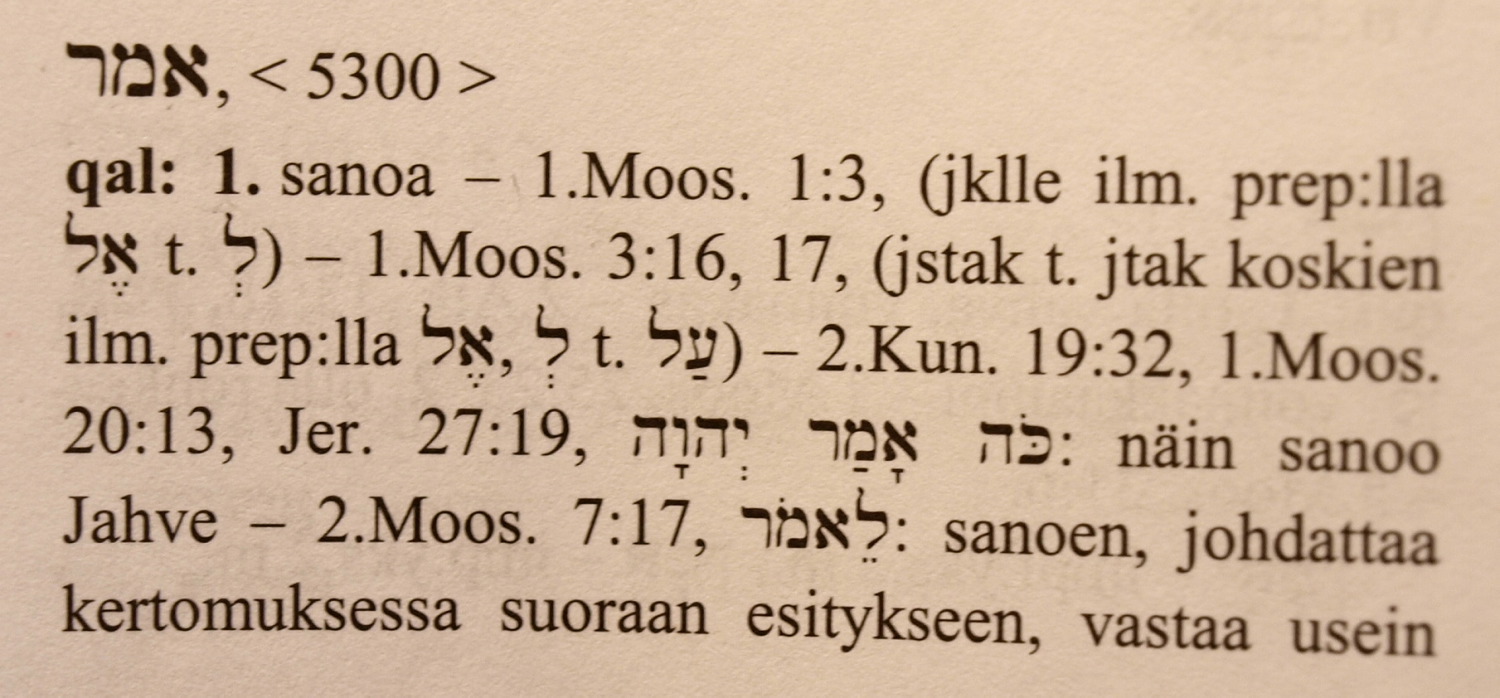
Lauseen kuudes sana on maskuliinisukuinen substantiivi אל (eel):
The sixth word is a substantive in masculine אל (eel):

Edelliseen sanaan liittyvä kakkostyypin suffiksi löytyy seuraavasta taulukosta:
The previous word has a suffix of type 2, which you'll see in the table below:

Lauseen seitsemäs sana on maskuliinisukuinen substantiivi בן (ben), johon liittyvä ykköstyypin suffiksi näkyy edellä olevasta taulukosta:
The seventh word is a substantive in masculine בן (ben), and it's suffix of type 1 you'll find in the table above:

Lauseen kahdeksas ja yhdeksäs sana ovat persoonapronomineja, jotka löytyvät alla olevasta taulukosta:
The eighth and the ninth word are personal pronouns, and you'll find them in the table below:

Lauseen kymmenes sana on maskuliinisukuinen substantiivi יומ (jom), jonka määrätty muoto on היומ (haj-jom):
The tenth word is a substantive in masculine יומ (jom), and it's definite form is חיומ (haj-jom):

HUOM.: Lauseen kymmenenteen sanaan EI LIITY demonstratiivipronominia "tämä", joten ei voida myöskään kääntää "tänä päivänä"!
NOTE: There is NO demonstrative pronoun "this" with the tenth word, therefore we can't translate "this day"!

Lauseen viimeinen sana on verbi ילד (jalad), johon liittyvä suffixi näkyy aikaisemmasta taulukosta:
The last word is a verb ילד (jalad), and you'll find it's suffix in the former table:

Jokainen yrittäköön itse löytää hyvän käännöksen kyseiseen tekstiin!
Try to make your own translation!
Minun ehdotukseni on seuraavanlainen:
MINÄ JULISTAN/KERRON LISÄKSI TEHTÄVÄN
HERRA SANOI JUMALANI
SINÄ (OLET) POIKANI
MINÄ SINÄ PÄIVÄNÄ SINUT SYNNYTÄN
My translation:
I'LL TELL YOU/DECLARE MORE THAN A TASK
THE LORD SAID MY GOD
YOU (ARE) MY SON
THE DAY I'LL GIVE YOU BIRTH
Jos jätämme "lisäykseltä" tuntuvan toisen rivin pois, syntyy järkevä ajatus:
LISÄKSI MINÄ JULISTAN TEHTÄVÄN:
SINÄ (OLET) POIKANI,
SINÄ PÄIVÄNÄ MINÄ SYNNYTÄN SINUT.
If we put away the second row, which reminds me of an addition, the idea of the verse is clear:
I'LL TELL YOU MORE THAN A TASK
YOU (ARE) MY SON
THE DAY I'LL GIVE YOU BIRTH
VAI pitäisikö toinen ja kolmas rivi kääntää näin:
HERRA SANOI SINÄ (OLET) JUMALANI POIKANI... mitä järkeä siinä olisi... kuka olisi siis "HERRA", kuka "JUMALA" ja kuka "POIKA"?
OR should we translate the second and the third row like this: THE LORD SAID YOU (ARE) MY GOD MY SON... do you find any sense in it... who is "LORD", who is "GOD" and who is "SON"?
"Se päivä"/"sinä päivänä" viittaa edellisen jakeen ajatukseen Kuninkaan asettamisesta Siionin pyhälle vuorelle, sillä onhan kuoleman voittaminen/ylösnusemus Jeesuksen kuninkuuden totinen perusta!
"The day" refers to the previous verse and it's idea of the moment/day when God set the king upon his holy hill of Zion, for isn't it the defeat of death/resurrection of Jesus that is the base/foundation of his kingdom!
Apostolien tekojen kirjoittaja on ymmärtänyt kyseisen Psalmin ennustuksen toteutuneen juuri Jeesuksen ylösnousemuksessa (Ap.t. 13: 33, 34).
The author of the Acts has understood that the Psalm text in question was fulfilled in the resurrection of Jesus (Acts 13: 33, 34).
Jumalan valtava tehtävä/urakka: TOTEUTTAA PELASTUSSUUNNITELMANSA JEESUKSESSA JA TUODA HÄNET ULOS "HAUDAN KOHDUSTA" KUOLEMAN VOITTAJANA! (vrt. Room. 1: 4)
God's enormous task: TO FULFILL HIS PLAN OF SALVATION IN JESUS AND BRING HIM OUT AS THE VINNER OF DEATH FROM "THE WOMB OF THE TOMB"! (compare Rom. 1: 4)
Tilaa:
Blogitekstit (Atom)